It seems that Dubai police are about to follow some other emirates and offer discounts on traffic offence fines.
I'm struggling to understand how that will help to improve the standard of driving.
Gulf News has the report here.
Showing posts with label safety. Show all posts
Showing posts with label safety. Show all posts
Sunday, July 31, 2011

Tuesday, June 15, 2010
Midday break begins today
The midday break for outdoor workers, from 12.30 to 3pm, begins today. It ends on September 15 so it includes Ramadan.
The workers will have been looking forward to it I'm sure, because temperatures are already in the forties celcius and yesterday's humidity was about as bad as it gets - it was around 95% according to weather reports.
The Ministry of Labour says most companies obey the law on the break but even so they say that 'over 650' companies were fined for non-compliance last year.
They've given a phone number to which any member of the public can anonymously report violations. It's 800665.
The workers will have been looking forward to it I'm sure, because temperatures are already in the forties celcius and yesterday's humidity was about as bad as it gets - it was around 95% according to weather reports.
The Ministry of Labour says most companies obey the law on the break but even so they say that 'over 650' companies were fined for non-compliance last year.
They've given a phone number to which any member of the public can anonymously report violations. It's 800665.
Friday, May 28, 2010
Good news for the boys in blue

Some good news for the UAE's outdoor workers - the summer midday break will be extended by a month, running from June 15 to September 15.
It'll last through Ramadan this year too, which must be a huge relief for those workers who'll be fasting.
The bad news is that the hours of the break won't be extended, it will stay at 12.30 to 3pm.
When it was introduced in 2005 it was from 12.30 to 4pm, and the later finish is important because the hottest part of the day is often around 3pm. But construction companies complained and the next year it was shortened by one hour, where it's stayed.
Eighteen inspection teams from the Ministry of Labour will monitor compliance but it's inevitable that some companies will flout the law. MoL say their statistics show that more than 650 companies were fined last year for non-compliance.
Fines range from Dh10,000 and a ban on obtaining new labour permits for three months for a first offence to Dh30,000 and a ban on obtaining new work permits for one year for a third offence.
Monday, May 24, 2010
'Arrested'. But now what?
The story in my last two posts goes on.
According to Arabian Business, the drivers involved in the crass stupidity have been arrested by Dubai Police and the vehicles impounded.
It's a start, now we'll have to wait to see how justice is applied.
As I said in the earlier posts, I think it deserves nothing less than a life ban on owning or driving vehicles plus a lengthy jail term for deliberately endangering life.
But I don't for one moment think that's going to happen.
And apart from the the drivers doing the stunts there was a convoy of hangers-on accompanying them, cheering them on and filming them. They need to be arrested too, charged with aiding and abetting the offences.
What the eventual outcome will demonstrate is just how serious the authorities are about stamping down on dangerous, irresponsible driving and in promoting road safety.
So far it seems to have been a half-hearted campaign without much successs, a couple of weeks emphasis here and there on specific things such as tailgating, child seats or mobile phone use. I've seen no reduction in any of those offences, in fact with mobile phone use it seems to me to be on the increase.
So this will be an interesting one to follow because it's such a serious, deliberate flouting of the laws that could have had disastrous consequences for innocent drivers caught up in the lunacy.
The Arabian Business report is basic and short on any detail, but they say the police have promised a full statement shortly. What they have is here.
According to Arabian Business, the drivers involved in the crass stupidity have been arrested by Dubai Police and the vehicles impounded.
It's a start, now we'll have to wait to see how justice is applied.
As I said in the earlier posts, I think it deserves nothing less than a life ban on owning or driving vehicles plus a lengthy jail term for deliberately endangering life.
But I don't for one moment think that's going to happen.
And apart from the the drivers doing the stunts there was a convoy of hangers-on accompanying them, cheering them on and filming them. They need to be arrested too, charged with aiding and abetting the offences.
What the eventual outcome will demonstrate is just how serious the authorities are about stamping down on dangerous, irresponsible driving and in promoting road safety.
So far it seems to have been a half-hearted campaign without much successs, a couple of weeks emphasis here and there on specific things such as tailgating, child seats or mobile phone use. I've seen no reduction in any of those offences, in fact with mobile phone use it seems to me to be on the increase.
So this will be an interesting one to follow because it's such a serious, deliberate flouting of the laws that could have had disastrous consequences for innocent drivers caught up in the lunacy.
The Arabian Business report is basic and short on any detail, but they say the police have promised a full statement shortly. What they have is here.
Saturday, May 22, 2010
Dangerous driving clip banned in UAE
My last post was about the totally irresponsible, life threatening driving deliberately carried out by a bunch of youths on Sheikh Zayed Road.
I gave a link to the YouTube clip showing the madness but a comment left on my post alerted me to a strange decision. When I clicked on the link my screen looked like this:

The rest of the world can view the clip, so why is it banned in the UAE?
At best it might be a misguided attempt to stop others copying the dangerous stupidity.
But the kind of brainless morons who are prepared to endanger other people's lives by such stupidity brag about it to each other and show each other the clips on their mobile phones.
I think that rather than being banned the clip should be widely publicised and used in educational campaigns. It should be used to demonstrate that such behaviour is not clever or adult but is childish, unintelligent, antisocial and irresponsible.
Those involved should be named, ridiculed and exposed as childish, irresponsible, life-threatening fools.
Then they should be jailed for endangering life, be banned from owning a vehicle or driving for life. Their punishment should also be used in educational campaigns to deter others from copying them.
If you're in the UAE and haven't seen the stupidity on film you can still, at least for now, accesss it through the website of The National newspaper, which carried the story. It's here.
I gave a link to the YouTube clip showing the madness but a comment left on my post alerted me to a strange decision. When I clicked on the link my screen looked like this:

The rest of the world can view the clip, so why is it banned in the UAE?
At best it might be a misguided attempt to stop others copying the dangerous stupidity.
But the kind of brainless morons who are prepared to endanger other people's lives by such stupidity brag about it to each other and show each other the clips on their mobile phones.
I think that rather than being banned the clip should be widely publicised and used in educational campaigns. It should be used to demonstrate that such behaviour is not clever or adult but is childish, unintelligent, antisocial and irresponsible.
Those involved should be named, ridiculed and exposed as childish, irresponsible, life-threatening fools.
Then they should be jailed for endangering life, be banned from owning a vehicle or driving for life. Their punishment should also be used in educational campaigns to deter others from copying them.
If you're in the UAE and haven't seen the stupidity on film you can still, at least for now, accesss it through the website of The National newspaper, which carried the story. It's here.
Friday, May 21, 2010
Life threatening lunacy
There's a new film on YouTube showing innocent motorists' lives being endangered by a bunch of brainless morons.
On Sheikh Zayed Road in Dubai, a 4x4 and a pick-up doing stunts while other traffic is around them.
Some stills from it:


After you've watched the clip here you'll probably prefer to use the Metro rather than driving.
On Sheikh Zayed Road in Dubai, a 4x4 and a pick-up doing stunts while other traffic is around them.
Some stills from it:


Dubai Police are efficient enough to identify the Eastern European ram-raid gang and to get massive amounts of information on the hit squad that assassinated Hamas commander Mahmoud al-Mabhouh.
Identifying the idiots in the clip should take the police about five minutes.
Deliberately putting other people's lives at risk like this deserves a lifetime driving ban, a lifetime ban on owning a vehicle and a lengthy jail term. And I mean lengthy.
The obvious question is whether they'll be arrested. Cynics will doubt it and will talk about wasta...
Identifying the idiots in the clip should take the police about five minutes.
Deliberately putting other people's lives at risk like this deserves a lifetime driving ban, a lifetime ban on owning a vehicle and a lengthy jail term. And I mean lengthy.
The obvious question is whether they'll be arrested. Cynics will doubt it and will talk about wasta...
After you've watched the clip here you'll probably prefer to use the Metro rather than driving.
Saturday, October 17, 2009
Another emergency evacuation
I hate to think what would happen if we had a real emergency.
Last month I was in the emergency evacuation incident at Dubai's Terminal 3 and I posted about the problems.
Yesterday we were in Souk Madinat Jumeirah and at 7pm had just placed our order in Dome coffee shop when the automated alarm started.
The recorded voice told us "An incident has occurred in the building...don't panic...don't use the lifts...go immediately to your designated assembly points"
Friday evening is a busy time at Souk Madinat so there were plenty of people eating, shopping, wandering about.
The people working in the shops and restaurants obviously knew what to do and where to go, to their designated assembly points. That's what they did.
For the rest of us it was confusion.
Some, maybe most, people ignored the message. Others wandered outside and stood around wondering what to do next.
Not a sign of a security person, no indication that anyone, a real live person, was in control. Just an automated message repeating itself.
Outside the main entrance there were three security people standing around, allowing pedestrians and vehicles to continue to pour into the building.
My guess is that they were unaware of the instruction to evacuate.
Chaos reigned for a while. People leaving were milling about by the entrance, some sitting on the steps, while newcomers were trying to push their way in.
Still no sign of anyone in control, no security or safety people directing or giving information.
After 10 minutes we gave up and went back to Dome. The staff were back in and told us there was a gas problem, it was being fixed and the kitchen would be working in a few minutes.
It's the basics being wrong that worries me.
You need someone in control, who is seen to be in control.
A real live person on the PA system, not a pre-recorded tape.
You need visible security/safety people directing, explaining, in control.
If the building is to be immediately evacuated you need to stop newcomers from entering. So security people need to be stationed at the entrances.
Obviously they need to be informed of the situation, so they need to be equipped with radios linked to the control room.
If it's a real emergency there's urgency involved here. Action has to be immediate.
Get people out and well away from the danger, quickly and in an orderly fashion, prevent newcomers from coming in, divert traffic.
None of that happened.
Last month I was in the emergency evacuation incident at Dubai's Terminal 3 and I posted about the problems.
Yesterday we were in Souk Madinat Jumeirah and at 7pm had just placed our order in Dome coffee shop when the automated alarm started.
The recorded voice told us "An incident has occurred in the building...don't panic...don't use the lifts...go immediately to your designated assembly points"
Friday evening is a busy time at Souk Madinat so there were plenty of people eating, shopping, wandering about.
The people working in the shops and restaurants obviously knew what to do and where to go, to their designated assembly points. That's what they did.
For the rest of us it was confusion.
Some, maybe most, people ignored the message. Others wandered outside and stood around wondering what to do next.
Not a sign of a security person, no indication that anyone, a real live person, was in control. Just an automated message repeating itself.
Outside the main entrance there were three security people standing around, allowing pedestrians and vehicles to continue to pour into the building.
My guess is that they were unaware of the instruction to evacuate.
Chaos reigned for a while. People leaving were milling about by the entrance, some sitting on the steps, while newcomers were trying to push their way in.
Still no sign of anyone in control, no security or safety people directing or giving information.
After 10 minutes we gave up and went back to Dome. The staff were back in and told us there was a gas problem, it was being fixed and the kitchen would be working in a few minutes.
It's the basics being wrong that worries me.
You need someone in control, who is seen to be in control.
A real live person on the PA system, not a pre-recorded tape.
You need visible security/safety people directing, explaining, in control.
If the building is to be immediately evacuated you need to stop newcomers from entering. So security people need to be stationed at the entrances.
Obviously they need to be informed of the situation, so they need to be equipped with radios linked to the control room.
If it's a real emergency there's urgency involved here. Action has to be immediate.
Get people out and well away from the danger, quickly and in an orderly fashion, prevent newcomers from coming in, divert traffic.
None of that happened.
Thursday, September 03, 2009
DXB T3 - what really happened
I'm in the UK but thought I'd give you a quick update on what really happened yesterday morning at Terminal 3.
The papers are dismissing the incident with just the short 'it was nothing' official statement:
A water leakage occurred in Concourse 2 of Dubai International Airport at 6:50am on Wednesday, an official source said. (Gulf News)
The water leak that occurred at Dubai Airports Concourse 2 at 6.50am affecting six remote gates has been rectified, an official source from Dubai Airport has said on Wednesday. (Khaleej Times)
Here's an eyewitness account - mine.
There was 'water leakage' but that doesn't quite explain what happened.
We were sitting having a coffee before going to Gate 209 for our Emirates flight, due to open in ten minutes.
There was an announcement that a fire had been detected and the building was to be immediately evacuated.
Lights simultaneously stated flashing a warning on all the fire alarms.
The problem was that the announcement, presumably automatic, kept stuttering like a jammed record, stopping and starting.
Sprinklers started pouring water into one small section of the terminal. That was the 'water leakage'.
I could see no fire nor smell any smoke.
It had all the makings of a system malfunction rather than a real emergency so while people did get ready to move we all stayed put.
There was no evidence of any fire or safety people hurrying about.
Then the extractor fans, again presumably as part of the automated system, started going full bore.
The noise from the fans was so loud that it was impossible to hear any announcements. In the abscence of visual electronic instructions that could be a real problem in a real emergency. A part of the fire safety system that needs to be looked at I would suggest.
Then people in uniform started running - but it was the cleaners!
A hell of a lot of water comes from sprinklers and the area was starting to flood. So the cleaning machines, the mops, the plastic barriers were rushed to the scene.
A crowd had gathered to view the new water feature and that's when Security got involved.
Yep, you guessed their priority: "No Photos! No photos!"
A hopeless cause, there were hundreds of people with digital and phone cameras.
Here are a couple:
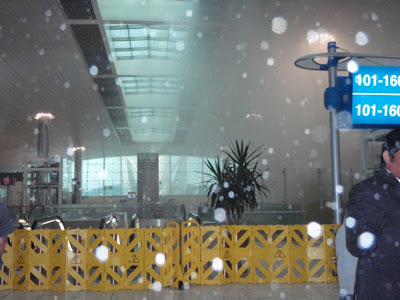

Gate 209 and several others were affected by the water so the aircraft had to be moved.
But to where?
There weren't many Emirates or airport staff around, apart from the cleaners, so milling around was order of the day. Hundreds of passengers who wondered which gate they now needed to go to plus hundreds more rubberneckers looking at the water.
Eventually some uniforms started shouting the destinations and their new gate numbers ("Birmingham Gate 150" for example)
We walked for, I'm not exaggerating, forty minutes (noticing by chance by glancing at the Flight Departures board that 150 had quietly changed to 144).
Good thing I noticed that.
Then a bus to the end of the airport where a line of planes was parked near the exhibition centre and we were dropped at one of them.
Fortunately it turned out to be the right one.
Interestingly the cabin crew I spoke to had no idea what had been happening.
Considering the chaos behind the scenes that must have been going on they actually handled it pretty well I thought. It can't be easy to re-organise several flights and hundreds (thousands?) of passengers at the last minute at a busy airport.
But instead of explaining exactly what had happened, what action they needed to take and how well they handled it, in other words transparency, we've got the inevitable obfuscation.
Just like the security guards trying to stop photography it's the usual pretend nothing happened mindset.
Tell us nothing. Keep it all secret. Everything's perfect, nothing ever goes wrong.
They missed the opportunity for brownie points by not explaining what a difficult situation they faced and how well they handled it.
Having said they handled it well there are a couple of things that obviously need looking at.
There's that very dangerous question of the extractor fan noise drowning out any announcements and, as there always is, the problem of lack of communication.
If you have to close a gate at the last minute and transfer the aircraft to a new one, station a staff member on it to advise passengers that a) they'll shortly be told which gate to go to; b) when the information is available WRITE IT ON A BOARD and place it at the closed gate.
With the only signs to Gate 150/144 pointing to the flooded closed-off area, meaning we had to go in the opposite direction to the signs, it would have helped to have a few more staff members directing traffic. As it was we walked to the far end of the terminal, down some stairs, back the length of the terminal again like a herd of gnu on migration, all following the leaders and hoping they knew where they were headed.
So yes, there was a problem with water but that was far from the whole story.
And the UK is cold, wet and very windy.
The papers are dismissing the incident with just the short 'it was nothing' official statement:
A water leakage occurred in Concourse 2 of Dubai International Airport at 6:50am on Wednesday, an official source said. (Gulf News)
The water leak that occurred at Dubai Airports Concourse 2 at 6.50am affecting six remote gates has been rectified, an official source from Dubai Airport has said on Wednesday. (Khaleej Times)
Here's an eyewitness account - mine.
There was 'water leakage' but that doesn't quite explain what happened.
We were sitting having a coffee before going to Gate 209 for our Emirates flight, due to open in ten minutes.
There was an announcement that a fire had been detected and the building was to be immediately evacuated.
Lights simultaneously stated flashing a warning on all the fire alarms.
The problem was that the announcement, presumably automatic, kept stuttering like a jammed record, stopping and starting.
Sprinklers started pouring water into one small section of the terminal. That was the 'water leakage'.
I could see no fire nor smell any smoke.
It had all the makings of a system malfunction rather than a real emergency so while people did get ready to move we all stayed put.
There was no evidence of any fire or safety people hurrying about.
Then the extractor fans, again presumably as part of the automated system, started going full bore.
The noise from the fans was so loud that it was impossible to hear any announcements. In the abscence of visual electronic instructions that could be a real problem in a real emergency. A part of the fire safety system that needs to be looked at I would suggest.
Then people in uniform started running - but it was the cleaners!
A hell of a lot of water comes from sprinklers and the area was starting to flood. So the cleaning machines, the mops, the plastic barriers were rushed to the scene.
A crowd had gathered to view the new water feature and that's when Security got involved.
Yep, you guessed their priority: "No Photos! No photos!"
A hopeless cause, there were hundreds of people with digital and phone cameras.
Here are a couple:


Gate 209 and several others were affected by the water so the aircraft had to be moved.
But to where?
There weren't many Emirates or airport staff around, apart from the cleaners, so milling around was order of the day. Hundreds of passengers who wondered which gate they now needed to go to plus hundreds more rubberneckers looking at the water.
Eventually some uniforms started shouting the destinations and their new gate numbers ("Birmingham Gate 150" for example)
We walked for, I'm not exaggerating, forty minutes (noticing by chance by glancing at the Flight Departures board that 150 had quietly changed to 144).
Good thing I noticed that.
Then a bus to the end of the airport where a line of planes was parked near the exhibition centre and we were dropped at one of them.
Fortunately it turned out to be the right one.
Interestingly the cabin crew I spoke to had no idea what had been happening.
Considering the chaos behind the scenes that must have been going on they actually handled it pretty well I thought. It can't be easy to re-organise several flights and hundreds (thousands?) of passengers at the last minute at a busy airport.
But instead of explaining exactly what had happened, what action they needed to take and how well they handled it, in other words transparency, we've got the inevitable obfuscation.
Just like the security guards trying to stop photography it's the usual pretend nothing happened mindset.
Tell us nothing. Keep it all secret. Everything's perfect, nothing ever goes wrong.
They missed the opportunity for brownie points by not explaining what a difficult situation they faced and how well they handled it.
Having said they handled it well there are a couple of things that obviously need looking at.
There's that very dangerous question of the extractor fan noise drowning out any announcements and, as there always is, the problem of lack of communication.
If you have to close a gate at the last minute and transfer the aircraft to a new one, station a staff member on it to advise passengers that a) they'll shortly be told which gate to go to; b) when the information is available WRITE IT ON A BOARD and place it at the closed gate.
With the only signs to Gate 150/144 pointing to the flooded closed-off area, meaning we had to go in the opposite direction to the signs, it would have helped to have a few more staff members directing traffic. As it was we walked to the far end of the terminal, down some stairs, back the length of the terminal again like a herd of gnu on migration, all following the leaders and hoping they knew where they were headed.
So yes, there was a problem with water but that was far from the whole story.
And the UK is cold, wet and very windy.
Wednesday, June 24, 2009
PS to dangerous driving post
Yesterday I posted about the standard of driving on our roads, tailgating being one of the dangerous stunts all-too-many drivers insist on inflicting on the rest of us.
Here's an example from this morning, on Al Sufouh Road where traffic from Dubai Marina and Palm Jumeirah merges.
The right lane in the photograph is about to end and traffic in it has to merge left.
In about 100metres, a few seconds, the road becomes three lanes so there's ample room to overtake.
The small white sedan is doing the right thing travelling at the speed limit of 80kph and there's nowhere for him to go, but a 4X4 driver isn't prepared to travel at the speed limit and can't wait for an overtaking opportunity. He got much closer than this too.

Here's an example from this morning, on Al Sufouh Road where traffic from Dubai Marina and Palm Jumeirah merges.
The right lane in the photograph is about to end and traffic in it has to merge left.
In about 100metres, a few seconds, the road becomes three lanes so there's ample room to overtake.
The small white sedan is doing the right thing travelling at the speed limit of 80kph and there's nowhere for him to go, but a 4X4 driver isn't prepared to travel at the speed limit and can't wait for an overtaking opportunity. He got much closer than this too.

Tuesday, June 23, 2009
Our dangerous roads
Over the past few months I came to the conclusion that the standard of driving in Dubai has improved.
Wrong. It was a false conclusion.
The last two days I've encountered a couple of the things which I haven't come across for a while but used to see on a daily basis, pushing into queues and using the hard shoulder to get to the front.
That made me realise that what's happened to give a false impression of the driving standards is that there are more roads with fewer vehicles on them.
It's not that people have learnt that it's wrong to drive to the front of a queue in the wrong lane and then force their way in. The reality is that there are fewer tailbacks so there isn't the opportunity for them to do it.
The other thing that hasn't changed is speeding, or overspeeding as I'm amused to see it referred to in the media.
On Sheikh Zayed Road when the speed limit was reduced to 100kph I was, and still am, amazed at the large number of drivers who observe the limit.
But inevitably there's a percentage who still weave in and out at high speed, tailgating and light flashing. Fewer than previously according to my observation but still enough to make life dangerous.
I don't see much change in the speed at which buses, trucks and minivans are hurled about the streets either.
There's a problem with speed, too, in residential areas. A major factor is that we have too many divided multi-lane roads (dual carriageways) in residential areas, which the morons take full advantage of. About three weeks ago Chris Saul complained that it was a fact of life in Old Town and we also have it in Dubai Marina. Speed limit is clearly signed as 60kph but between 80 and 100 is the norm.
I don't know whether the crash, death and injury figures are coming down but I'm guessing that I see fewer crashes simply because we have more roads and less congestion.
That brings me on to the World Health Organisation's Global Status Report on Road Safety.
With things changing so rapidly in Dubai the figures are not all that meaningful because they're from 2007. However they do tell us what the situation was then and how we compared with other countries.
A couple of things to add about the report. Countries submitted their own data and they self-rated themselves on law enforcement and that needs to be kept in mind when reading the country profiles.
The report shows that in 2007 our roads were amongst the most dangerous in the world. For deaths on the roads we had 37.1 deaths per 100,000 poulation against a global average of 18.8.
I have to question the UAE's percentage claims on law enforcement because, as I've said many times, that's where we have a problem. Too few traffic police out on the streets and too many people getting away with dangerous driving.
Yet on enforcement of speed laws our police claim 7 out of 10, on enforcing seat belt laws they claim 7 out of 10. I think that sounds very optimistic.
Another interesting point was pedestrian deaths. That's received a lot of coverage with calls for more pedestrian bridges, something that we certainly do need. But is that the answer? If you compare our pedestrian deaths figure with other countries it seems to be a simplistic view of the problem.
I looked at countries which I know or which are relevant to many people living here. Pedestrians account for 28% of our road deaths. Compare that with Singapore, where they drive very much more slowly and have plenty of pedestrian crossings, but their figure is 27%. The UK has 21%, Australia 13%, South Africa 39%, while in the Philippines Metro Manila has a staggering 51%.
(I looked at India too of course, given the big Indian community here, but the figures they gave are too vague, with 'other' and 'unspecified' making up 40% of the the breakdown).
Another section of the UAE country report shows two things which need urgent attention:
While we have a seat belt law it's shown as not applying to all occupants of a vehicle. It should.
We have no child restraints law. We should have.
WHO report is here.
Wrong. It was a false conclusion.
The last two days I've encountered a couple of the things which I haven't come across for a while but used to see on a daily basis, pushing into queues and using the hard shoulder to get to the front.
That made me realise that what's happened to give a false impression of the driving standards is that there are more roads with fewer vehicles on them.
It's not that people have learnt that it's wrong to drive to the front of a queue in the wrong lane and then force their way in. The reality is that there are fewer tailbacks so there isn't the opportunity for them to do it.
The other thing that hasn't changed is speeding, or overspeeding as I'm amused to see it referred to in the media.
On Sheikh Zayed Road when the speed limit was reduced to 100kph I was, and still am, amazed at the large number of drivers who observe the limit.
But inevitably there's a percentage who still weave in and out at high speed, tailgating and light flashing. Fewer than previously according to my observation but still enough to make life dangerous.
I don't see much change in the speed at which buses, trucks and minivans are hurled about the streets either.
There's a problem with speed, too, in residential areas. A major factor is that we have too many divided multi-lane roads (dual carriageways) in residential areas, which the morons take full advantage of. About three weeks ago Chris Saul complained that it was a fact of life in Old Town and we also have it in Dubai Marina. Speed limit is clearly signed as 60kph but between 80 and 100 is the norm.
I don't know whether the crash, death and injury figures are coming down but I'm guessing that I see fewer crashes simply because we have more roads and less congestion.
That brings me on to the World Health Organisation's Global Status Report on Road Safety.
With things changing so rapidly in Dubai the figures are not all that meaningful because they're from 2007. However they do tell us what the situation was then and how we compared with other countries.
A couple of things to add about the report. Countries submitted their own data and they self-rated themselves on law enforcement and that needs to be kept in mind when reading the country profiles.
The report shows that in 2007 our roads were amongst the most dangerous in the world. For deaths on the roads we had 37.1 deaths per 100,000 poulation against a global average of 18.8.
I have to question the UAE's percentage claims on law enforcement because, as I've said many times, that's where we have a problem. Too few traffic police out on the streets and too many people getting away with dangerous driving.
Yet on enforcement of speed laws our police claim 7 out of 10, on enforcing seat belt laws they claim 7 out of 10. I think that sounds very optimistic.
Another interesting point was pedestrian deaths. That's received a lot of coverage with calls for more pedestrian bridges, something that we certainly do need. But is that the answer? If you compare our pedestrian deaths figure with other countries it seems to be a simplistic view of the problem.
I looked at countries which I know or which are relevant to many people living here. Pedestrians account for 28% of our road deaths. Compare that with Singapore, where they drive very much more slowly and have plenty of pedestrian crossings, but their figure is 27%. The UK has 21%, Australia 13%, South Africa 39%, while in the Philippines Metro Manila has a staggering 51%.
(I looked at India too of course, given the big Indian community here, but the figures they gave are too vague, with 'other' and 'unspecified' making up 40% of the the breakdown).
Another section of the UAE country report shows two things which need urgent attention:
While we have a seat belt law it's shown as not applying to all occupants of a vehicle. It should.
We have no child restraints law. We should have.
WHO report is here.
Thursday, June 18, 2009
Safety, what safety?
The National reports a near tragedy in Dubai Mall yesterday, when a four year old boy fell 5.5 metres down an open and unfenced manhole.
He was extremely lucky that a ladder in the hole broke his fall and he sustained only minor injuries with some facial bruising and a cut finger.
The worker was inside the hole getting safety barriers to place around it when the accident happened.
Whoa! Hold it right there.
The 'accident' didn't happen, it was caused.
Caused by the fact that the barriers were inside the hole, meaning that it had to be left unsecured while they were brought out. They should be stored outside the hole so that they could be erected around it before the cover was taken off.
Basic, basic stuff. Stupidity. Would the safety manager care to comment I wonder?
But that's not the worst information in the story.
Look at this:
In the 30 minutes...it took for the ambulance to arrive at the scene – apparently it had difficulty reaching the accident spot because of height restrictions...
They built it too low for an ambulance to get in! What about the fire brigade? Must be too low for them too I imagine.
I know construction people read this blog and I'd appreciate your input.
I can't believe there are no building regulations about access for emergency services. If there are then the mall must contravene them.
If that's the case it must be closed until modifications which protect public safety are completed.
Here's The National report.
He was extremely lucky that a ladder in the hole broke his fall and he sustained only minor injuries with some facial bruising and a cut finger.
The worker was inside the hole getting safety barriers to place around it when the accident happened.
Whoa! Hold it right there.
The 'accident' didn't happen, it was caused.
Caused by the fact that the barriers were inside the hole, meaning that it had to be left unsecured while they were brought out. They should be stored outside the hole so that they could be erected around it before the cover was taken off.
Basic, basic stuff. Stupidity. Would the safety manager care to comment I wonder?
But that's not the worst information in the story.
Look at this:
In the 30 minutes...it took for the ambulance to arrive at the scene – apparently it had difficulty reaching the accident spot because of height restrictions...
They built it too low for an ambulance to get in! What about the fire brigade? Must be too low for them too I imagine.
I know construction people read this blog and I'd appreciate your input.
I can't believe there are no building regulations about access for emergency services. If there are then the mall must contravene them.
If that's the case it must be closed until modifications which protect public safety are completed.
Here's The National report.
Monday, June 15, 2009
Suspected food poisoning kills two more children.
A little girl died from food poisoning in Sharjah a couple of weeks ago and now there's another similar tragedy, this time in Dubai.
Two young children have died, food poisoning being the probable cause.
Five year old Nathan and his seven year old sister Chelsea were rushed to hospital by their mother, who was suffering from the same symptoms, after eating a take-away Chinese meal.
Nathan was pronounced dead on arrival, Chelsea was treated in intensive care but couldn't be saved and their mother recovered.
The health authorities are investigating and they know which restaurant the food came from, so I assume we'll soon know what, where, how.
Worldwide, thousands of people die each year from food poisoning, even in the most advanced countries, so it's probably inevitable that we'll have some deaths here. But what a waste of three young lives. Particularly as basic hygiene and correct food handling could prevent it.
Gulf News has the story.
Two young children have died, food poisoning being the probable cause.
Five year old Nathan and his seven year old sister Chelsea were rushed to hospital by their mother, who was suffering from the same symptoms, after eating a take-away Chinese meal.
Nathan was pronounced dead on arrival, Chelsea was treated in intensive care but couldn't be saved and their mother recovered.
The health authorities are investigating and they know which restaurant the food came from, so I assume we'll soon know what, where, how.
Worldwide, thousands of people die each year from food poisoning, even in the most advanced countries, so it's probably inevitable that we'll have some deaths here. But what a waste of three young lives. Particularly as basic hygiene and correct food handling could prevent it.
Gulf News has the story.
Sunday, June 07, 2009
Sharjah's dangerous food
There's an alarming report in The National this morning about the safety of eating out in Sharjah.
It follows the death of little Marwa Faisal, the four year old who tragically died from food poisoning in the emirate a week ago. The rest of her family were seriously affected too, although no source of the problem has yet been announced.
Now Sharjah Municipality reports that of the 1,588 restaurants and cafeterias its inspectors checked last year only 223 met the minimum requirements.
Only 223 out of 1,588. That's astonishing.
Of the 1,365 not meeting minimum requirements, 891 were issued with warnings and 474 were closed temporarily until they improved.
Those really are frightening figures.
The municiplity reports that outlets were guilty of poor maintenance, serving food that had passed its use-by date, black mould on kitchen surfaces, flaking paint falling on to food and staff not observing correct food safety procedures.
At least as bad as those is the practice of turning off refrigerators at night to save power, a common cause of food poisoning, particularly in summer of course. The municipality said they're working to eradicate this practice too.
All of this is total and disgraceful disregard for the health of the public from an incredible 86 percent of the industry.
It goes right down the chain too. In Al Ain last month police and inspectors carried out spot checks on trucks. They found 143 carrying produce to markets and restaurants without proper permits. Over three days they caught 11 trucks that were unfit for the safe transport of food.
The food wasn't being transported at the correct, safe temperature and 437kg had been spoilt, damaged or was below standard for service and sale to the public. But if they hadn't been intercepted it would have been sold to the public I'm sure. And how many more trucks are there ferrying food around unrefrigerated?
The municipalities and the health authorities around the emirates say they're cracking down and various programmes are being put in place to get on top, and stay on top, of the practices.
There's regular talk about draconian jail sentences here for various law breaking activities. I'd like to see them for these practices, which to me are very serious crimes, threatening the health and even the lives of people.
The full story is in The National.
It follows the death of little Marwa Faisal, the four year old who tragically died from food poisoning in the emirate a week ago. The rest of her family were seriously affected too, although no source of the problem has yet been announced.
Now Sharjah Municipality reports that of the 1,588 restaurants and cafeterias its inspectors checked last year only 223 met the minimum requirements.
Only 223 out of 1,588. That's astonishing.
Of the 1,365 not meeting minimum requirements, 891 were issued with warnings and 474 were closed temporarily until they improved.
Those really are frightening figures.
The municiplity reports that outlets were guilty of poor maintenance, serving food that had passed its use-by date, black mould on kitchen surfaces, flaking paint falling on to food and staff not observing correct food safety procedures.
At least as bad as those is the practice of turning off refrigerators at night to save power, a common cause of food poisoning, particularly in summer of course. The municipality said they're working to eradicate this practice too.
All of this is total and disgraceful disregard for the health of the public from an incredible 86 percent of the industry.
It goes right down the chain too. In Al Ain last month police and inspectors carried out spot checks on trucks. They found 143 carrying produce to markets and restaurants without proper permits. Over three days they caught 11 trucks that were unfit for the safe transport of food.
The food wasn't being transported at the correct, safe temperature and 437kg had been spoilt, damaged or was below standard for service and sale to the public. But if they hadn't been intercepted it would have been sold to the public I'm sure. And how many more trucks are there ferrying food around unrefrigerated?
The municipalities and the health authorities around the emirates say they're cracking down and various programmes are being put in place to get on top, and stay on top, of the practices.
There's regular talk about draconian jail sentences here for various law breaking activities. I'd like to see them for these practices, which to me are very serious crimes, threatening the health and even the lives of people.
The full story is in The National.
Thursday, May 28, 2009
One up one down
A couple of pictures I took the other day.
First, better late than never a Civil Defence facility is going up between Dubai Marina and the Tecom free zone.

For years now thousands of people have been living in apartments at the marina, visiting the shops and restaurants and working in Media City, Internet City & Knowledge Village.
There's also Jumeirah Lake Towers and Palm Jumeirah and all the development across the other side of Sheikh Zayed Road, so there's a lot of property and a very large number of people.
There have been fires in the area, including Atlantis and the fatal Fortune Towers blaze, so it's a relief to see that the area will soon be getting the protection of a local Civil Defence facility.
Then something I posted about ages ago, the demolition of Oasis Beach Hotel.
It's still going on, slowly, centimetre by centimetre, and creating a lot of dust across The Walk.

First, better late than never a Civil Defence facility is going up between Dubai Marina and the Tecom free zone.

For years now thousands of people have been living in apartments at the marina, visiting the shops and restaurants and working in Media City, Internet City & Knowledge Village.
There's also Jumeirah Lake Towers and Palm Jumeirah and all the development across the other side of Sheikh Zayed Road, so there's a lot of property and a very large number of people.
There have been fires in the area, including Atlantis and the fatal Fortune Towers blaze, so it's a relief to see that the area will soon be getting the protection of a local Civil Defence facility.
Then something I posted about ages ago, the demolition of Oasis Beach Hotel.
It's still going on, slowly, centimetre by centimetre, and creating a lot of dust across The Walk.

The speed it's coming down suggests it'll be some months yet before it's all gone.
Sunday, October 26, 2008
Please sort out the roadsigns!
I've complained many times about the bad management of signage by the RTA.
While the design of the signs is good - large, with clear, easy-to-read wording, Arabic and English - they are all to often misleading, confusing, in the wrong place. They add to the dangers of driving in Dubai and they do cause crashes, I've seen it myself.
Now there's a frantic campaign under way to make them even more confusing.
It's gone beyond just changing signs which indicate the way to suburbs to the new obsession with showing the way to roads we've never heard of.
I came across this sign yesterday on Interchange 4. They used to indicate the way to "Dubai" or to "Jebel Ali. Abu Dhabi", which was clear, concise, not confusing.
So they had to go, to be replaced by:

While the design of the signs is good - large, with clear, easy-to-read wording, Arabic and English - they are all to often misleading, confusing, in the wrong place. They add to the dangers of driving in Dubai and they do cause crashes, I've seen it myself.
Now there's a frantic campaign under way to make them even more confusing.
It's gone beyond just changing signs which indicate the way to suburbs to the new obsession with showing the way to roads we've never heard of.
I came across this sign yesterday on Interchange 4. They used to indicate the way to "Dubai" or to "Jebel Ali. Abu Dhabi", which was clear, concise, not confusing.
So they had to go, to be replaced by:

Wednesday, July 16, 2008
Still on the dangerous driving theme...
Sorry, I seem to be back on my driving standards rant again.
But I couldn't help but post about this story in The National.
Motorists are ignoring tougher laws on the use of mobile phones while driving, despite police issuing thousands of fines.
Fourteen out of 15 people questioned in Dubai yesterday admitted to talking on the phone while driving, while 11 said they sent text messages.
Col Saif Muhair al Mazrouei, the deputy director general of the traffic department for Dubai police, this week said it was difficult to penalise offenders.
“We can’t issue any absent fines as we have to make people aware of the violation, which will mean having to stop drivers on the roads and that will be a very challenging thing to do,” he said.
However, he admitted it was difficult to catch people due to the high number of cars with tinted windows.
“It’s difficult to see if they are on the phone when the windows are tinted, especially at night,” said Brig Zaffin.
I hardly know where to begin. Even if the police can see through heavily tinted windows, presumably in violation of the law, it's 'challenging' to stop the drivers. Fourteen out of fifteen respondents admitted using their mobile while driving. The 'tougher' laws are being ignored, so what does that say about their toughness? It's not about education, apparently: Everyone knew it was illegal to drive and talk on the phone at the same time.
This sentence gives an idea of the mindset of drivers:
Some people said the police were focused more on serious offences, such as driving without a licence or reckless driving, to pull over people for talking on their phones.
"More serious offences" means they think driving without a licence is more serious than talking on the mobile and "reckless driving" does not in their minds include talking on the mobile.
How do you deal with that kind of stupidity?
The story is here.
But I couldn't help but post about this story in The National.
Motorists are ignoring tougher laws on the use of mobile phones while driving, despite police issuing thousands of fines.
Fourteen out of 15 people questioned in Dubai yesterday admitted to talking on the phone while driving, while 11 said they sent text messages.
Col Saif Muhair al Mazrouei, the deputy director general of the traffic department for Dubai police, this week said it was difficult to penalise offenders.
“We can’t issue any absent fines as we have to make people aware of the violation, which will mean having to stop drivers on the roads and that will be a very challenging thing to do,” he said.
However, he admitted it was difficult to catch people due to the high number of cars with tinted windows.
“It’s difficult to see if they are on the phone when the windows are tinted, especially at night,” said Brig Zaffin.
I hardly know where to begin. Even if the police can see through heavily tinted windows, presumably in violation of the law, it's 'challenging' to stop the drivers. Fourteen out of fifteen respondents admitted using their mobile while driving. The 'tougher' laws are being ignored, so what does that say about their toughness? It's not about education, apparently: Everyone knew it was illegal to drive and talk on the phone at the same time.
This sentence gives an idea of the mindset of drivers:
Some people said the police were focused more on serious offences, such as driving without a licence or reckless driving, to pull over people for talking on their phones.
"More serious offences" means they think driving without a licence is more serious than talking on the mobile and "reckless driving" does not in their minds include talking on the mobile.
How do you deal with that kind of stupidity?
The story is here.
It's a start...
Dubai Roads and Transport Authority launches road safety drive targeting trucks
Staff Report
Published: July 15, 2008, 23:40
Dubai: The Dubai Roads and Transport Authority (RTA) has launched a road safety campaign, which will crack down on heavy vehicles.
Working with Dubai Police, the campaign aims to reduce traffic accidents involving heavy trucks, deter reckless driving and increase respect for the rights of road users.
That's what a report in Gulf News tells us today.
It should have been done years ago, not in knee-jerk reaction to the recent tragedies. Had it been, people who have been killed would still be alive.
Let's hope that it's not just another of the short-term reactions to recent events that will disappear almost as soon as it's started.
But as the cliche has it, better late than never.
At least some action is being taken and we can only hope that it's an ongoing initiative and that we soon see some positive results.
The full report is here.
Staff Report
Published: July 15, 2008, 23:40
Dubai: The Dubai Roads and Transport Authority (RTA) has launched a road safety campaign, which will crack down on heavy vehicles.
Working with Dubai Police, the campaign aims to reduce traffic accidents involving heavy trucks, deter reckless driving and increase respect for the rights of road users.
That's what a report in Gulf News tells us today.
It should have been done years ago, not in knee-jerk reaction to the recent tragedies. Had it been, people who have been killed would still be alive.
Let's hope that it's not just another of the short-term reactions to recent events that will disappear almost as soon as it's started.
But as the cliche has it, better late than never.
At least some action is being taken and we can only hope that it's an ongoing initiative and that we soon see some positive results.
The full report is here.
Tuesday, July 15, 2008
How to stop the road carnage?
Five deaths in one accident, making ten in five days have yet again highlighted the danger of Dubai's roads.
At the end of my earlier post about it I said: We keep talking about it, we keep saying the obvious, that action must be taken but the crashes and the fires keep happening.
And more and more people continue to needlessly, and avoidably, lose their lives.
A couple of comments on the post continued the thought:
Jad Aoun said...
Honestly, this is getting really ridculous. How many people must die, how many accidents must we see before the police become more proactive? Police action here is very reactive. With the opening of Garhoud Bridge, it was easily predicted that cars would come flying down the new overpass from Deira. All they did was put up signs warning motorists that the road is 'monitored' and the speed limit is 80. Try traveling at 80 and you'll get knocked off the road by speeding cars until they reach the speed camera near Wafi. Its a complete joke - cameras and patrols need to be out in greater force. Its still a breeze to speed without getting caught.
dave said...
Agree with jad aoun, it seems that the carnage is endless, and the measures by the RTA & Police are clearly not working. Coupled to this is the lack of educational campaigns, it seems that increased penalties are the only measure that the Govt understands how to implement.
This is yet another tragedy of the loss of innocent lives in the UAE.
I couldn't aqree more with Jad Aoun and Dave. The authorities are reactive, minor penalties seem to be the only measure being taken.
It all seems to me to be out of control. Time goes by, more and more people are killed, nothing changes. Nothing happens to stop it.
I don't believe in complaining for the sake of it, I believe in constructive criticism.
So what do I think the authorities should be doing?
Well, the task is massive because the entire road/driving/licensing/training/vehicle testing situation needs revamping.
It's almost a case of starting again as far as I can see and briefly the basic points I think need addressing are these.
All residents wanting a licence should have to pass a local driving test. No more giving of licences based on an existing overseas licence.
We need very much better driving instructors, with strict requirements on qualifications. It's also essential that they have sufficient experience of local roads and driving conditions. We need a Highway Code, printed in all the necessary languages, which must be learnt and would be tested as part of the licence examination.
Drivers of heavy goods vehicles and those transporting passengers need special attention, with stricter testing and regular retesting.
We need many more traffic police out on the streets, highly trained and qualified, in marked and unmarked vehicles. One simple thing that would help immediately would be to get rid of the need to call the cops for every accident. They have to be called out for the slightest damage to a vehicle, which ties up a huge amount of their time. So sorting out the insurance reason behind this is a must.
All vehicles need to be tested regularly for roadworthiness, with special attention given to heavy goods vehicles and passenger transport, which need to be tested more frequently than private vehicles. Consideration should also be given to installing speed limiters in these vehicles.
Checks are needed on driving patterns of HGV and passenger vehicles, the hours worked, kilometres driven. Taxi drivers are included in this, there are too many stories of taxi drivers falling asleep at the end of a dangerously long shift. The EU regulations would be a good starting point for the policy.
The roads themselves contribute to the problem. Check out the traffic in cities like Cairo, Delhi - chaotic, do whatever you like, every man for himself...they get away with it because the choked traffic moves very slowly. In Dubai the driving is the same but at speeds of way over 100kph. So we're back to driver training to cope with the big, wide, flat, racetrack roads.
It's too late to change the confusing combination of US & UK road systems, but there are measures which would make them a little less dangerous. Traffic lights on all U-turns for example. Short slip roads which give too little space to merge safely or to cross lanes should be adjusted. Pedestrian crossings need to be installed - putting fences down the middle of a road isn't the answer, people still need to cross the road.
Signage is a problem that needs fixing. Road signage is all too often confusing and unclear, creating an unnecessary hazard. Fixing the problem is easy.
We need laws with heavy penalties for traffic offences. Heavy penalties not just a fine of a few dirhams. The more serious the offence the heavier the punishment. So jumping red lights, tailgating, talking on a mobile phone while driving, drink driving, driving on the hard shoulder...all should be very severely punished. Speeding is another, with increasing penalties on a sliding scale related to the speed above the speed limit.
And underpinning everything, an ongoing, serious, wide-ranging education strategy. Road safety education in schools, educating future generations of drivers. Education by way of media campaigns for everyone, drivers and pedestrians. Education of company owners & managers so that they understand the dangers of forcing drivers to work too-long hours.
And in the short term, getting dangerous drivers off the roads immediately by confiscating vehicles and licences. With enough police to check that banned drivers are not defying the ban and driving.
Hand wringing doesn't help. Being reactive is useless. Talking endlessly about it achieves nothing. The need is to get ahead of the game, to acknowledge the problem, identify the causes and to take firm, positive action to resolve it.
And it's urgent.
At the end of my earlier post about it I said: We keep talking about it, we keep saying the obvious, that action must be taken but the crashes and the fires keep happening.
And more and more people continue to needlessly, and avoidably, lose their lives.
A couple of comments on the post continued the thought:
Jad Aoun said...
Honestly, this is getting really ridculous. How many people must die, how many accidents must we see before the police become more proactive? Police action here is very reactive. With the opening of Garhoud Bridge, it was easily predicted that cars would come flying down the new overpass from Deira. All they did was put up signs warning motorists that the road is 'monitored' and the speed limit is 80. Try traveling at 80 and you'll get knocked off the road by speeding cars until they reach the speed camera near Wafi. Its a complete joke - cameras and patrols need to be out in greater force. Its still a breeze to speed without getting caught.
dave said...
Agree with jad aoun, it seems that the carnage is endless, and the measures by the RTA & Police are clearly not working. Coupled to this is the lack of educational campaigns, it seems that increased penalties are the only measure that the Govt understands how to implement.
This is yet another tragedy of the loss of innocent lives in the UAE.
I couldn't aqree more with Jad Aoun and Dave. The authorities are reactive, minor penalties seem to be the only measure being taken.
It all seems to me to be out of control. Time goes by, more and more people are killed, nothing changes. Nothing happens to stop it.
I don't believe in complaining for the sake of it, I believe in constructive criticism.
So what do I think the authorities should be doing?
Well, the task is massive because the entire road/driving/licensing/training/vehicle testing situation needs revamping.
It's almost a case of starting again as far as I can see and briefly the basic points I think need addressing are these.
All residents wanting a licence should have to pass a local driving test. No more giving of licences based on an existing overseas licence.
We need very much better driving instructors, with strict requirements on qualifications. It's also essential that they have sufficient experience of local roads and driving conditions. We need a Highway Code, printed in all the necessary languages, which must be learnt and would be tested as part of the licence examination.
Drivers of heavy goods vehicles and those transporting passengers need special attention, with stricter testing and regular retesting.
We need many more traffic police out on the streets, highly trained and qualified, in marked and unmarked vehicles. One simple thing that would help immediately would be to get rid of the need to call the cops for every accident. They have to be called out for the slightest damage to a vehicle, which ties up a huge amount of their time. So sorting out the insurance reason behind this is a must.
All vehicles need to be tested regularly for roadworthiness, with special attention given to heavy goods vehicles and passenger transport, which need to be tested more frequently than private vehicles. Consideration should also be given to installing speed limiters in these vehicles.
Checks are needed on driving patterns of HGV and passenger vehicles, the hours worked, kilometres driven. Taxi drivers are included in this, there are too many stories of taxi drivers falling asleep at the end of a dangerously long shift. The EU regulations would be a good starting point for the policy.
The roads themselves contribute to the problem. Check out the traffic in cities like Cairo, Delhi - chaotic, do whatever you like, every man for himself...they get away with it because the choked traffic moves very slowly. In Dubai the driving is the same but at speeds of way over 100kph. So we're back to driver training to cope with the big, wide, flat, racetrack roads.
It's too late to change the confusing combination of US & UK road systems, but there are measures which would make them a little less dangerous. Traffic lights on all U-turns for example. Short slip roads which give too little space to merge safely or to cross lanes should be adjusted. Pedestrian crossings need to be installed - putting fences down the middle of a road isn't the answer, people still need to cross the road.
Signage is a problem that needs fixing. Road signage is all too often confusing and unclear, creating an unnecessary hazard. Fixing the problem is easy.
We need laws with heavy penalties for traffic offences. Heavy penalties not just a fine of a few dirhams. The more serious the offence the heavier the punishment. So jumping red lights, tailgating, talking on a mobile phone while driving, drink driving, driving on the hard shoulder...all should be very severely punished. Speeding is another, with increasing penalties on a sliding scale related to the speed above the speed limit.
And underpinning everything, an ongoing, serious, wide-ranging education strategy. Road safety education in schools, educating future generations of drivers. Education by way of media campaigns for everyone, drivers and pedestrians. Education of company owners & managers so that they understand the dangers of forcing drivers to work too-long hours.
And in the short term, getting dangerous drivers off the roads immediately by confiscating vehicles and licences. With enough police to check that banned drivers are not defying the ban and driving.
Hand wringing doesn't help. Being reactive is useless. Talking endlessly about it achieves nothing. The need is to get ahead of the game, to acknowledge the problem, identify the causes and to take firm, positive action to resolve it.
And it's urgent.
Tuesday, March 18, 2008
Church security
At the weekend a reader e-mailed me about hightened security at St. Mary's Church.
"We were not allowed to park next to the church, and we had to be screened by guards with metal detectors (a la airport security)."
I'd seen nothing in the papers then, but yesterday there was a report in Gulf News about it.
Police are saying it's a 'routine security measure' and 'there is nothing to worry about' and I suppose it just could be, with Easter coming up.
It could also, of course, be that the authorities have received some intelligence that something untoward is planned.
One to watch.
Gulf News report is here.
"We were not allowed to park next to the church, and we had to be screened by guards with metal detectors (a la airport security)."
I'd seen nothing in the papers then, but yesterday there was a report in Gulf News about it.
Police are saying it's a 'routine security measure' and 'there is nothing to worry about' and I suppose it just could be, with Easter coming up.
It could also, of course, be that the authorities have received some intelligence that something untoward is planned.
One to watch.
Gulf News report is here.
Monday, February 04, 2008
The clean-up.
After the gales a couple of days ago the work gangs are out cleaning up the mess, including some of the newly-planted date palms that took a bit of a battering. Quite a few had to be straightened. I noticed a few of the established palms had snapped off just below the fronds too, so the gusts must have been even stronger than I thought.

I was reminded of something I've talked about before too - nothing but a red flag to protect cleaners on Dubai's dangerous roads...

That really needs looking into.

I was reminded of something I've talked about before too - nothing but a red flag to protect cleaners on Dubai's dangerous roads...

That really needs looking into.
Subscribe to:
Posts (Atom)