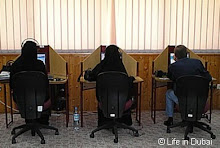
Whiled away a couple of fun, interesting hours with fellow bloggers on a Dubai Eye Radio programme this morning.
Suzanne Radford and Alexander McNabb on Dubai Today's 'Techno Tuesday' decided they'd devote most of the programme to blogging and bloggers.
But that's not what this post is about. Far better, if you're interested, to go to the podcast, which Alex said should be up soon on their website. Instead of me telling you about it you can listen to the programme.
No, the post is another in my 'bloody useless signage' series.
Over the years of blogging I've complained many times about the road signage being confusing, inaccurate and dangerous. In this case it simply doesn't exist.
I've driven out to Global Village the past two weekends (I must post about that too), going from Al Sufouh along Umm Suqueim Road to Arabian Ranches.
I had no idea that Studio City, where Dubai Eye is located, is there, right across the road from Arabian Ranches.
Today I saw the reason. Following Suzanne's instructions on how to get there I found it was exactly the way I'd driven to Global Village. But I didn't see one single sign to Studio City. Nor when I got there did I see a sign identifying the place.
Millions spent on developing a new 'city', plenty of companies operating from it and not a sign anywhere.
You can get a temporary one run up for a few dirhams if the permanent one isn't ready.
Although why it wouldn't be I can't visualise. The time it took to build the impressive-ish entrance gate was plenty of time to get a sign made.
Come on guys, it isn't rocket science it's just road signage. How can you get it so wrong so consistently?
Back to the programme for a minute to guide you to the bloggers who participated in it. Reflecting the blogosphere, they're all very different. But as they were hand-picked by Alex they're all well worth a read.
Dubai-ified
Mich Cafe
Who-sane
Hellwa Fashion
A Nabulsi Story
andfaraway
And Alex' own blog is Fake Plastic Souks
You can listen to the podcast here, at DubaiEye103.8
Showing posts with label roads. Show all posts
Tuesday, January 25, 2011
Monday, November 23, 2009
Dubai's road deaths down
I've noted in a few posts that, although there are still plenty of morons out there, road behaviour generally seems to be improving in Dubai.
That seems to be supported by RTA figures for 2008 which show that road deaths are down for the first time in eight years. Speed is a major factor in fatalities and I've noticed a definite slowing down since, for example, Sheikh Zayed Road's limit was reduced to 100kph.
Sadly there were 157 unnecessary deaths caused by road crashes last year, but that's better than the 180 killed in 2007.
On SZR, where the speed limit was reduced from 120kph to 100kph, the stretch between between Defence Roundabout and Interchange 5 had a dramatic drop in fatalities, down from 29 in 2007 to 10 last year.
Speed is a factor in crashes in general but it isn't just the reduction of speed limits that have helped to reduce the danger on our roads, it's much more complicated than that, as Maitha bin Udai, CEO of Traffic & Roads Agency, said.
I've noticed not only a reduction in speed but also, for example, far fewer people driving along the hard shoulder, far fewer driving aggressively and forcing their way in. That's not down to speed limits but to less frustration with log-jammed traffic. A frustrated driver is a dangerous driver. The improvement in traffic flow is thanks to the opening of so many new roads and intersections plus the slightly fewer vehicles on the roads.
There's a long way to go but at least the figures are going in the right direction at long last.
Gulf News has the story here.
That seems to be supported by RTA figures for 2008 which show that road deaths are down for the first time in eight years. Speed is a major factor in fatalities and I've noticed a definite slowing down since, for example, Sheikh Zayed Road's limit was reduced to 100kph.
Sadly there were 157 unnecessary deaths caused by road crashes last year, but that's better than the 180 killed in 2007.
On SZR, where the speed limit was reduced from 120kph to 100kph, the stretch between between Defence Roundabout and Interchange 5 had a dramatic drop in fatalities, down from 29 in 2007 to 10 last year.
Speed is a factor in crashes in general but it isn't just the reduction of speed limits that have helped to reduce the danger on our roads, it's much more complicated than that, as Maitha bin Udai, CEO of Traffic & Roads Agency, said.
I've noticed not only a reduction in speed but also, for example, far fewer people driving along the hard shoulder, far fewer driving aggressively and forcing their way in. That's not down to speed limits but to less frustration with log-jammed traffic. A frustrated driver is a dangerous driver. The improvement in traffic flow is thanks to the opening of so many new roads and intersections plus the slightly fewer vehicles on the roads.
There's a long way to go but at least the figures are going in the right direction at long last.
Gulf News has the story here.
Monday, November 09, 2009
Money wasted by lack of planning
Back in March/April there were several press reports of the billions owed to UK contractors by Dubai government-related companies, discussions at ministerial level etc.
Inevitably it isn't just UK companies owed money and The National has now reported that unsurprisingly Japanese builders are in the same position with billions owed to them.
I've made the point several times in the past that it's a disaster for Brand Dubai, for Dubai's reputation as a reliable place to do business, a threat to Dubai's commercial plans for the future, so I won't repeat myself.
But I will repeat myself about the huge wastage of money caused by a lack of planning. If so many billions weren't wasted there'd be more money available to pay bills.
Yesterday for the first time in a few months I drove onto Road 611 from Al Sufouh Road, over the interchange which crosses SZR.
611 is a new road, this section was finished not very long ago.
Now it looks like this:


A big section being dug up, diversions in place, a road junction being replaced by a flyover.
Population projections, tourist arrival projections, traffic density and projections were all available yet must have been ignored because what was obviously an inadequate road plan was created, approved and built.
Not only billions wasted but it causes unnecessary extra pollution, traffic jams, lost productivity and driver frustration.
All because not enough competent thought was given to planning.
And this is just one of many examples all over the city.
Japanese contractors owed billions by Dubai firms.
Inevitably it isn't just UK companies owed money and The National has now reported that unsurprisingly Japanese builders are in the same position with billions owed to them.
I've made the point several times in the past that it's a disaster for Brand Dubai, for Dubai's reputation as a reliable place to do business, a threat to Dubai's commercial plans for the future, so I won't repeat myself.
But I will repeat myself about the huge wastage of money caused by a lack of planning. If so many billions weren't wasted there'd be more money available to pay bills.
Yesterday for the first time in a few months I drove onto Road 611 from Al Sufouh Road, over the interchange which crosses SZR.
611 is a new road, this section was finished not very long ago.
Now it looks like this:


A big section being dug up, diversions in place, a road junction being replaced by a flyover.
Population projections, tourist arrival projections, traffic density and projections were all available yet must have been ignored because what was obviously an inadequate road plan was created, approved and built.
Not only billions wasted but it causes unnecessary extra pollution, traffic jams, lost productivity and driver frustration.
All because not enough competent thought was given to planning.
And this is just one of many examples all over the city.
Japanese contractors owed billions by Dubai firms.
Wednesday, October 28, 2009
Dangerous road management
Over the almost four years of this blog I've often complained about poor management of our roads which adds immeasurably to the dangers and chaos.
A lot of it's simple basic stuff - bad road design, merging lanes far too short, misleading signage, that sort of thing.
There was another classic example this morning on Al Sufouh Road, the stretch between Dubai Marina and Knowledge Village.
For many months they've been digging the road up and diversions have been in place, which we've all got used to.
This morning it had all changed.

Not a word of warning, no sign saying 'Changed traffic conditions'.
Suddenly we're on a stretch of road we don't know, with no idea where the road we need is, no idea which lane we need to be in.
Inevitably there was confusion, lots of slowing down, lane changing, last-second swerving.
It's not rocket science is it, it's simple admin, a procedure.
"If we change a road layout we must alert motorists to that fact with a warning sign".
Yet they can't do it.
A lot of it's simple basic stuff - bad road design, merging lanes far too short, misleading signage, that sort of thing.
There was another classic example this morning on Al Sufouh Road, the stretch between Dubai Marina and Knowledge Village.
For many months they've been digging the road up and diversions have been in place, which we've all got used to.
This morning it had all changed.

Not a word of warning, no sign saying 'Changed traffic conditions'.
Suddenly we're on a stretch of road we don't know, with no idea where the road we need is, no idea which lane we need to be in.
Inevitably there was confusion, lots of slowing down, lane changing, last-second swerving.
It's not rocket science is it, it's simple admin, a procedure.
"If we change a road layout we must alert motorists to that fact with a warning sign".
Yet they can't do it.
Tuesday, June 23, 2009
Our dangerous roads
Over the past few months I came to the conclusion that the standard of driving in Dubai has improved.
Wrong. It was a false conclusion.
The last two days I've encountered a couple of the things which I haven't come across for a while but used to see on a daily basis, pushing into queues and using the hard shoulder to get to the front.
That made me realise that what's happened to give a false impression of the driving standards is that there are more roads with fewer vehicles on them.
It's not that people have learnt that it's wrong to drive to the front of a queue in the wrong lane and then force their way in. The reality is that there are fewer tailbacks so there isn't the opportunity for them to do it.
The other thing that hasn't changed is speeding, or overspeeding as I'm amused to see it referred to in the media.
On Sheikh Zayed Road when the speed limit was reduced to 100kph I was, and still am, amazed at the large number of drivers who observe the limit.
But inevitably there's a percentage who still weave in and out at high speed, tailgating and light flashing. Fewer than previously according to my observation but still enough to make life dangerous.
I don't see much change in the speed at which buses, trucks and minivans are hurled about the streets either.
There's a problem with speed, too, in residential areas. A major factor is that we have too many divided multi-lane roads (dual carriageways) in residential areas, which the morons take full advantage of. About three weeks ago Chris Saul complained that it was a fact of life in Old Town and we also have it in Dubai Marina. Speed limit is clearly signed as 60kph but between 80 and 100 is the norm.
I don't know whether the crash, death and injury figures are coming down but I'm guessing that I see fewer crashes simply because we have more roads and less congestion.
That brings me on to the World Health Organisation's Global Status Report on Road Safety.
With things changing so rapidly in Dubai the figures are not all that meaningful because they're from 2007. However they do tell us what the situation was then and how we compared with other countries.
A couple of things to add about the report. Countries submitted their own data and they self-rated themselves on law enforcement and that needs to be kept in mind when reading the country profiles.
The report shows that in 2007 our roads were amongst the most dangerous in the world. For deaths on the roads we had 37.1 deaths per 100,000 poulation against a global average of 18.8.
I have to question the UAE's percentage claims on law enforcement because, as I've said many times, that's where we have a problem. Too few traffic police out on the streets and too many people getting away with dangerous driving.
Yet on enforcement of speed laws our police claim 7 out of 10, on enforcing seat belt laws they claim 7 out of 10. I think that sounds very optimistic.
Another interesting point was pedestrian deaths. That's received a lot of coverage with calls for more pedestrian bridges, something that we certainly do need. But is that the answer? If you compare our pedestrian deaths figure with other countries it seems to be a simplistic view of the problem.
I looked at countries which I know or which are relevant to many people living here. Pedestrians account for 28% of our road deaths. Compare that with Singapore, where they drive very much more slowly and have plenty of pedestrian crossings, but their figure is 27%. The UK has 21%, Australia 13%, South Africa 39%, while in the Philippines Metro Manila has a staggering 51%.
(I looked at India too of course, given the big Indian community here, but the figures they gave are too vague, with 'other' and 'unspecified' making up 40% of the the breakdown).
Another section of the UAE country report shows two things which need urgent attention:
While we have a seat belt law it's shown as not applying to all occupants of a vehicle. It should.
We have no child restraints law. We should have.
WHO report is here.
Wrong. It was a false conclusion.
The last two days I've encountered a couple of the things which I haven't come across for a while but used to see on a daily basis, pushing into queues and using the hard shoulder to get to the front.
That made me realise that what's happened to give a false impression of the driving standards is that there are more roads with fewer vehicles on them.
It's not that people have learnt that it's wrong to drive to the front of a queue in the wrong lane and then force their way in. The reality is that there are fewer tailbacks so there isn't the opportunity for them to do it.
The other thing that hasn't changed is speeding, or overspeeding as I'm amused to see it referred to in the media.
On Sheikh Zayed Road when the speed limit was reduced to 100kph I was, and still am, amazed at the large number of drivers who observe the limit.
But inevitably there's a percentage who still weave in and out at high speed, tailgating and light flashing. Fewer than previously according to my observation but still enough to make life dangerous.
I don't see much change in the speed at which buses, trucks and minivans are hurled about the streets either.
There's a problem with speed, too, in residential areas. A major factor is that we have too many divided multi-lane roads (dual carriageways) in residential areas, which the morons take full advantage of. About three weeks ago Chris Saul complained that it was a fact of life in Old Town and we also have it in Dubai Marina. Speed limit is clearly signed as 60kph but between 80 and 100 is the norm.
I don't know whether the crash, death and injury figures are coming down but I'm guessing that I see fewer crashes simply because we have more roads and less congestion.
That brings me on to the World Health Organisation's Global Status Report on Road Safety.
With things changing so rapidly in Dubai the figures are not all that meaningful because they're from 2007. However they do tell us what the situation was then and how we compared with other countries.
A couple of things to add about the report. Countries submitted their own data and they self-rated themselves on law enforcement and that needs to be kept in mind when reading the country profiles.
The report shows that in 2007 our roads were amongst the most dangerous in the world. For deaths on the roads we had 37.1 deaths per 100,000 poulation against a global average of 18.8.
I have to question the UAE's percentage claims on law enforcement because, as I've said many times, that's where we have a problem. Too few traffic police out on the streets and too many people getting away with dangerous driving.
Yet on enforcement of speed laws our police claim 7 out of 10, on enforcing seat belt laws they claim 7 out of 10. I think that sounds very optimistic.
Another interesting point was pedestrian deaths. That's received a lot of coverage with calls for more pedestrian bridges, something that we certainly do need. But is that the answer? If you compare our pedestrian deaths figure with other countries it seems to be a simplistic view of the problem.
I looked at countries which I know or which are relevant to many people living here. Pedestrians account for 28% of our road deaths. Compare that with Singapore, where they drive very much more slowly and have plenty of pedestrian crossings, but their figure is 27%. The UK has 21%, Australia 13%, South Africa 39%, while in the Philippines Metro Manila has a staggering 51%.
(I looked at India too of course, given the big Indian community here, but the figures they gave are too vague, with 'other' and 'unspecified' making up 40% of the the breakdown).
Another section of the UAE country report shows two things which need urgent attention:
While we have a seat belt law it's shown as not applying to all occupants of a vehicle. It should.
We have no child restraints law. We should have.
WHO report is here.
Sunday, May 10, 2009
Adding to the problems
If street sweeping trucks are sent out during the morning peak traffic time they're worsening the traffic jams.
But it's a regular event.
This morning at 8.30 there was a lengthening queue of us caught up behind this dust-creator...

There's regular chaos on Al Wasl Road too, morning peak traffic being the time they send the gardeners out with their waste collection trucks blocking one lane.
Traffic congestion costs businesses in Dubai, according to our beloved RTA, several billion dirhams a year. Not to mention frustration and drivers suddenly having to change lanes, both recipes for a crash.
Just a suggestion. Why not send the trucks out to block the roads before and/or after the peak times?
But it's a regular event.
This morning at 8.30 there was a lengthening queue of us caught up behind this dust-creator...

There's regular chaos on Al Wasl Road too, morning peak traffic being the time they send the gardeners out with their waste collection trucks blocking one lane.
Traffic congestion costs businesses in Dubai, according to our beloved RTA, several billion dirhams a year. Not to mention frustration and drivers suddenly having to change lanes, both recipes for a crash.
Just a suggestion. Why not send the trucks out to block the roads before and/or after the peak times?
Sunday, April 26, 2009
Ready for more chaos?
Our beloved RTA has announced even more chaos on the roads roadworks.
It's all very necessary, it's good for the future and it'll be great when the work is finished...but for those of us here now it means more chaos on critical roads, more delays, probably terminal construction fatigue.
The two areas which will make life more difficult for me are Trade Centre Roundabout, which is being replaced with flyovers and 'signalised intersection', and Al Wasl Road on which the traffic intersections will be replaced with underpasses.
I know we need it, I complain about the traffic bottlenecks on Al Wasl Road every time I'm stuck in them, which is often.
Here's a drawing of what the four Al Wasl Road intersections will become:

They say the construction schedule will be announced shortly but I can't see it taking less than a year at the very least. Beach Road will be a whole lot of fun to drive along while this is going on!
I wonder whether the completion of the Creek extension across Al Wasl Road will be done at the same time? Wouldn't it be a relief to have it all finished and out of the way in one hit rather than a year's chaos for the intersection work followed by another year of chaos for the Creek work.
It's all very necessary, it's good for the future and it'll be great when the work is finished...but for those of us here now it means more chaos on critical roads, more delays, probably terminal construction fatigue.
The two areas which will make life more difficult for me are Trade Centre Roundabout, which is being replaced with flyovers and 'signalised intersection', and Al Wasl Road on which the traffic intersections will be replaced with underpasses.
I know we need it, I complain about the traffic bottlenecks on Al Wasl Road every time I'm stuck in them, which is often.
Here's a drawing of what the four Al Wasl Road intersections will become:

They say the construction schedule will be announced shortly but I can't see it taking less than a year at the very least. Beach Road will be a whole lot of fun to drive along while this is going on!
I wonder whether the completion of the Creek extension across Al Wasl Road will be done at the same time? Wouldn't it be a relief to have it all finished and out of the way in one hit rather than a year's chaos for the intersection work followed by another year of chaos for the Creek work.
Tuesday, April 07, 2009
The inevitable
On Saturday I posted about the dangerous intersection that's been created on one of Dubai Marina's bridges.
This morning:


The BMW was coming across the bridge, the taxi was presumably already on the roundabout.
It happens to be one I saw but I bet there have been more, and there'll be many more in the future too.
As I've said several times in the past, bad road design and bad road signage contribute to the crash statistics.
This morning:


The BMW was coming across the bridge, the taxi was presumably already on the roundabout.
It happens to be one I saw but I bet there have been more, and there'll be many more in the future too.
As I've said several times in the past, bad road design and bad road signage contribute to the crash statistics.
Saturday, November 29, 2008
Ads add to jams
One thing the RTA could do to ease drivers' inconvenience is to ban the convoys of mobile advertisements which add to the congestion on our roads.
Three of them have been cruising around New Dubai in recent days - I got stuck behind this one when he peeled off from the other two to have a break.

Another thing they could do is to stop the street sweeping trucks from clogging up the roads during peak hours. There's one regularly around Al Sufouh Road near the Tecom area during the morning peak traffic. It crawls along the inside lane, as it must, effectively preventing traffic from using that lane and forcing it to merge into other heavily congested lanes.
The RTA website says Customer Centricity and their vision is Safe and Smooth Transport for all. That would be helped by the removal of these two little unnecessary irritations.
Three of them have been cruising around New Dubai in recent days - I got stuck behind this one when he peeled off from the other two to have a break.

Another thing they could do is to stop the street sweeping trucks from clogging up the roads during peak hours. There's one regularly around Al Sufouh Road near the Tecom area during the morning peak traffic. It crawls along the inside lane, as it must, effectively preventing traffic from using that lane and forcing it to merge into other heavily congested lanes.
The RTA website says Customer Centricity and their vision is Safe and Smooth Transport for all. That would be helped by the removal of these two little unnecessary irritations.
Tuesday, November 11, 2008
Stop saying accident!
Just yesterday I was complaining about the motorist quoted as saying no one should be blamed in such a situation, as it was an accident.
He's not alone, far too many people think that 'accidents' simply happen, we're not to blame, and so we can obviously do nothing to prevent them.
There was another example which had me ranting at the radio this morning.
Dubai Eye news had an item on a high profile case in the UK, relating to the death of two young brothers and serious injuries to their father caused by a drunk driver. He is now serving seven years in jail.
They referred to it as 'an accident'.
I do wish the media would stop using the word. It encourages people to think that those who cause these things are completely blameless.
I also said in that post yesterday the inevitable planning incompetence, the recently finished roads were all wrong so they've been dug up. So we have single lanes, cones and diversions everywhere, temporary roundabouts... the roads I was talking about are in Knowledge Village and on Al Sufouh Road into Dubai Marina.
Here's what I'm talking about. I took this photograph in September last year. You can see a completed, landscaped roundabout in the foreground:

Here it is now:

Not the RTA's fault I hasten to add. The RTA didn't exist when the 'planning' was done for this.
We have it all over 'New Dubai'. Roads planned so badly they have to be demolished, re-planned and re-built so that they actually do the job they were supposed to do.
He's not alone, far too many people think that 'accidents' simply happen, we're not to blame, and so we can obviously do nothing to prevent them.
There was another example which had me ranting at the radio this morning.
Dubai Eye news had an item on a high profile case in the UK, relating to the death of two young brothers and serious injuries to their father caused by a drunk driver. He is now serving seven years in jail.
They referred to it as 'an accident'.
I do wish the media would stop using the word. It encourages people to think that those who cause these things are completely blameless.
I also said in that post yesterday the inevitable planning incompetence, the recently finished roads were all wrong so they've been dug up. So we have single lanes, cones and diversions everywhere, temporary roundabouts... the roads I was talking about are in Knowledge Village and on Al Sufouh Road into Dubai Marina.
Here's what I'm talking about. I took this photograph in September last year. You can see a completed, landscaped roundabout in the foreground:

Here it is now:

Not the RTA's fault I hasten to add. The RTA didn't exist when the 'planning' was done for this.
We have it all over 'New Dubai'. Roads planned so badly they have to be demolished, re-planned and re-built so that they actually do the job they were supposed to do.
Sunday, October 26, 2008
Please sort out the roadsigns!
I've complained many times about the bad management of signage by the RTA.
While the design of the signs is good - large, with clear, easy-to-read wording, Arabic and English - they are all to often misleading, confusing, in the wrong place. They add to the dangers of driving in Dubai and they do cause crashes, I've seen it myself.
Now there's a frantic campaign under way to make them even more confusing.
It's gone beyond just changing signs which indicate the way to suburbs to the new obsession with showing the way to roads we've never heard of.
I came across this sign yesterday on Interchange 4. They used to indicate the way to "Dubai" or to "Jebel Ali. Abu Dhabi", which was clear, concise, not confusing.
So they had to go, to be replaced by:
While the design of the signs is good - large, with clear, easy-to-read wording, Arabic and English - they are all to often misleading, confusing, in the wrong place. They add to the dangers of driving in Dubai and they do cause crashes, I've seen it myself.
Now there's a frantic campaign under way to make them even more confusing.
It's gone beyond just changing signs which indicate the way to suburbs to the new obsession with showing the way to roads we've never heard of.
I came across this sign yesterday on Interchange 4. They used to indicate the way to "Dubai" or to "Jebel Ali. Abu Dhabi", which was clear, concise, not confusing.
So they had to go, to be replaced by:
Saturday, October 11, 2008
Signage, fish and terrorism
Road signage, whale sharks and terrorism laws don't have anything in common except that they're subjects on my mind today, so this is a bit of a mixed bag of a post.
First the road signage and a detail related to our new address system which I've talked about previously.
Having road names and building numbers is obviously the best address system, as proven around the world for over a hundred years.
But to drag the directional signs on our roads into it is a huge mistake. As I've said before, the directional signs should remain as they are, to suburbs. Like this:

Instead, the RTA is changing the signs to things like this:

Where the hell is that?
It's hard enough trying to find our way around Dubai as it is, with the endless construction, diversions, new roads, moron drivers, without this confusing signage.
We know we want to go to, for example, Umm Suqeim 1 or Al Quoz or Al Barsha. We can't be expected to learn and remember thousands of street names.
I passed the sign to Al Rasaas Rd while driving along Sheikh Zayed Road earlier today. It was pointing to an exit in the direction of Jumeirah/Umm Suqeim...or it could have been to a flyover looping across to somewhere in entirely the opposite direction such as Al Barsha. I have no idea and the sign does nothing but confuse me.
So, feedback to the RTA. The new addressing system is great, but please don't confuse it with directional roadsigns. They are two totally different things.
And then the fishy business going on at Atlantis with the captive whale shark.
Gulf News has a major 'free the whale shark' campaign under way and it's getting an inordinate amount of radio air time. On Thursday the International Herald Tribune ran an Associated Press story about it, which you can read here.
I really don't need to say more about the subject than obviously the animal should be released the moment she's fit enough.
What interests me about it all is the appalling way the hotel has handled its PR over the issue. They've acted in the same way over the other negative stories in the media here and overseas, about rooms not being available, of no water, of running out of beer and wine, of no parking space. The PR strategy seems to be ignore it and it'll go away, which is absolutely the worst possible approach.
Look at this para from the AP story carried in the IHT:
Representatives of Atlantis resort, which is located on a man-made island built in the shape of a palm tree, did not return calls to the AP on Thursday. They also did not respond to AP's request to speak to one of the marine specialists the hotel says monitors the whale shark around the clock.
That kind of non-communication raises all sorts of doubts and questions.
They originally announced that the whale shark was in their aquarium for medical treatment after fishermen had found it in distress. But they fudged around the timing of her release in the one interview I've heard, since when they've gone completely to ground.
Full marks for helping the animal. But refusing to say even that she will be released leads to the suspicion that they intend to keep her as an attraction for the paying public.
That leads naturally to suspicions about the capture by fishermen, particularly as it was just before the hotel's opening. And to whether the announcement of it was nothing more than a sales pitch to let the paying public know she was in their aquarium.
The answer is simple - call a media conference, announce that the animal was in distress, that they're doing all they can to restore it to health and the moment it's recovered sufficiently they will release it. That gives the hotel nothing but good publicity.
Instead they've ignored the many opportunities they've been given. In this day and age I can't believe any company could handle their PR so badly.
There's an old truism. It ain't the problem that's the problem, the way you handle it is the problem.
And so to terrorism laws.
Again this is something I've talked about in the past. The terrorism laws introduced by our governments are open to mis-use and abuse by our own governments and their agencies. And they're doing it.
The latest example is the UK government using their terrorism laws to freeze billions of pounds of Icelandic bank assets held in the UK.
Here's what the Financial Times has to say:
Financial crime lawyers said the government's un-precedented decision to apply the freezing order for purposes other than tackling terrorism opened the way to its use in other cases centred on commercial and political interests.
The Treasury's action on Wednesday to protect the deposits of British account holders has highlighted broader concerns that some security-related laws passed since the September 11 2001 terrorist attacks are so widely drafted they are open to abuse.
I had many a debate when the laws were being introduced in the US, the UK, Australia and I seemed to be a voice in the wilderness. The general opinion was 'we need the laws to catch the terrorists' and 'our government can be trusted'. As I argued at the time, that's naive in the extreme.
I've talked before about the previous Australian government's use of terrorism laws in the case against Dr Haneef, which was thrown out of court. You can read about that here.
Of the UK government's threat to use terrorism laws against climate change protesters, which you can read about here.
Now we see the use of them against institutions of a friendly country, as reported in the Financial Times which you can read here.
I'll simply repeat a few things I said in those previous posts:
And worst of all the naive belief that only the bad guys are affected by the terrorism laws. That innocent people will not be caught up in the paranoia. The reality is of course that any of us could be caught up in it.
...everyone, should be dealt with in a way that is consistent with our established values of justice, of fairness...overly draconian new terrorism laws are open to abuse and they will be abused.
If we allow our governments to erode and gradually destroy our established values, we're going backwards.
Terrorists are laughing - our own governments are doing their work for them. The destruction of our way of life is coming from within.
Sorry, if you stayed with me this far that is, I seem to have rambled on for much longer than I intended.
Now it's almost time to go out for dinner, to a Chinese restaurant we like very much at the top of Beach Road. I should post about that tomorrow because if you enjoy Chinese food you should give it a try.
First the road signage and a detail related to our new address system which I've talked about previously.
Having road names and building numbers is obviously the best address system, as proven around the world for over a hundred years.
But to drag the directional signs on our roads into it is a huge mistake. As I've said before, the directional signs should remain as they are, to suburbs. Like this:

Instead, the RTA is changing the signs to things like this:

Where the hell is that?
It's hard enough trying to find our way around Dubai as it is, with the endless construction, diversions, new roads, moron drivers, without this confusing signage.
We know we want to go to, for example, Umm Suqeim 1 or Al Quoz or Al Barsha. We can't be expected to learn and remember thousands of street names.
I passed the sign to Al Rasaas Rd while driving along Sheikh Zayed Road earlier today. It was pointing to an exit in the direction of Jumeirah/Umm Suqeim...or it could have been to a flyover looping across to somewhere in entirely the opposite direction such as Al Barsha. I have no idea and the sign does nothing but confuse me.
So, feedback to the RTA. The new addressing system is great, but please don't confuse it with directional roadsigns. They are two totally different things.
And then the fishy business going on at Atlantis with the captive whale shark.
Gulf News has a major 'free the whale shark' campaign under way and it's getting an inordinate amount of radio air time. On Thursday the International Herald Tribune ran an Associated Press story about it, which you can read here.
I really don't need to say more about the subject than obviously the animal should be released the moment she's fit enough.
What interests me about it all is the appalling way the hotel has handled its PR over the issue. They've acted in the same way over the other negative stories in the media here and overseas, about rooms not being available, of no water, of running out of beer and wine, of no parking space. The PR strategy seems to be ignore it and it'll go away, which is absolutely the worst possible approach.
Look at this para from the AP story carried in the IHT:
Representatives of Atlantis resort, which is located on a man-made island built in the shape of a palm tree, did not return calls to the AP on Thursday. They also did not respond to AP's request to speak to one of the marine specialists the hotel says monitors the whale shark around the clock.
That kind of non-communication raises all sorts of doubts and questions.
They originally announced that the whale shark was in their aquarium for medical treatment after fishermen had found it in distress. But they fudged around the timing of her release in the one interview I've heard, since when they've gone completely to ground.
Full marks for helping the animal. But refusing to say even that she will be released leads to the suspicion that they intend to keep her as an attraction for the paying public.
That leads naturally to suspicions about the capture by fishermen, particularly as it was just before the hotel's opening. And to whether the announcement of it was nothing more than a sales pitch to let the paying public know she was in their aquarium.
The answer is simple - call a media conference, announce that the animal was in distress, that they're doing all they can to restore it to health and the moment it's recovered sufficiently they will release it. That gives the hotel nothing but good publicity.
Instead they've ignored the many opportunities they've been given. In this day and age I can't believe any company could handle their PR so badly.
There's an old truism. It ain't the problem that's the problem, the way you handle it is the problem.
And so to terrorism laws.
Again this is something I've talked about in the past. The terrorism laws introduced by our governments are open to mis-use and abuse by our own governments and their agencies. And they're doing it.
The latest example is the UK government using their terrorism laws to freeze billions of pounds of Icelandic bank assets held in the UK.
Here's what the Financial Times has to say:
Financial crime lawyers said the government's un-precedented decision to apply the freezing order for purposes other than tackling terrorism opened the way to its use in other cases centred on commercial and political interests.
The Treasury's action on Wednesday to protect the deposits of British account holders has highlighted broader concerns that some security-related laws passed since the September 11 2001 terrorist attacks are so widely drafted they are open to abuse.
I had many a debate when the laws were being introduced in the US, the UK, Australia and I seemed to be a voice in the wilderness. The general opinion was 'we need the laws to catch the terrorists' and 'our government can be trusted'. As I argued at the time, that's naive in the extreme.
I've talked before about the previous Australian government's use of terrorism laws in the case against Dr Haneef, which was thrown out of court. You can read about that here.
Of the UK government's threat to use terrorism laws against climate change protesters, which you can read about here.
Now we see the use of them against institutions of a friendly country, as reported in the Financial Times which you can read here.
I'll simply repeat a few things I said in those previous posts:
And worst of all the naive belief that only the bad guys are affected by the terrorism laws. That innocent people will not be caught up in the paranoia. The reality is of course that any of us could be caught up in it.
...everyone, should be dealt with in a way that is consistent with our established values of justice, of fairness...overly draconian new terrorism laws are open to abuse and they will be abused.
If we allow our governments to erode and gradually destroy our established values, we're going backwards.
Terrorists are laughing - our own governments are doing their work for them. The destruction of our way of life is coming from within.
Sorry, if you stayed with me this far that is, I seem to have rambled on for much longer than I intended.
Now it's almost time to go out for dinner, to a Chinese restaurant we like very much at the top of Beach Road. I should post about that tomorrow because if you enjoy Chinese food you should give it a try.
Saturday, October 04, 2008
RTA wants our feedback.
In Gulf News this morning there's more on the new street addressing system, which I was talking about yesterday.
When we say 'new' it means of course new to Dubai, the rest of the world has been using it for hundreds of years.
The report ends: The Roads and Transport Authority is awaiting feedback from the public on the new system.
OK, lines from the story and feedback...
RTA takes stock of new address system
A project follow-up committee has been set up and consists of experts from Dubai Municipality, Police, Civil Defence, Dubai Electricity and Water Authority, Unified Ambulance Centre, Emirates Posts Holding Group, etisalat and du.
My feedback on that - excellent, well done. The organisations involved are talking to each other, something that doesn't happen often enough.
...The new system is clear, concise, simple and easily memorised as it is based on building numbers, and names of road...
Feedback - excellent again. Not new, not rocket science but it's a system that's worked successfully for so long around the world.
But then it goes pear shaped.
This system will replace district names used in the old system
Feedback - no no no! Totally wrong, misleading, confusing, unnecessary.
You need to keep the district names and they need to be what's on directional roadsigns.
When we're driving around the already confusing road system trying to find our way to, let's say, Umm Suqeim, we need a sign that directs us to Umm Suqeim.
The last thing we need is a sign that doesn't mention the suburb but instead tells us it's the way to Ali Baba bin Abdulaziz Street.
PLEASE DON'T DO IT.
There's another little RTA piece on the same page and this one has me back in the land of the bewildered.
Here it is in full:
The Roads and Transport Authority (RTA) recently organised a training course designed to upgrade the profile and efficiency of its employees on etiquette and international protocol.
According to an RTA press release, more than 21 employees from different departments took part in the course which lasted for one week.
Among the etiquette skills gained by participants were etiquettes of communication, speech, introduction, dress, eating, gift presentation, telephone etiquette, social visits, banquets, visiting patients and decorations.
Look, I know it's a bizarre suggestion but instead of teaching them eating and gift presentation skills, wouldn't it be more useful to teach them about road planning? Teach them how to erect road signs in the right place? Teach them the importance of giving motorists advance warning of road changes?
(I was going to ask whether the visiting patients skill they're being taught refers to patients of road crashes, but as that would be facetious I won't).
You can find the stories here and here.
When we say 'new' it means of course new to Dubai, the rest of the world has been using it for hundreds of years.
The report ends: The Roads and Transport Authority is awaiting feedback from the public on the new system.
OK, lines from the story and feedback...
RTA takes stock of new address system
A project follow-up committee has been set up and consists of experts from Dubai Municipality, Police, Civil Defence, Dubai Electricity and Water Authority, Unified Ambulance Centre, Emirates Posts Holding Group, etisalat and du.
My feedback on that - excellent, well done. The organisations involved are talking to each other, something that doesn't happen often enough.
...The new system is clear, concise, simple and easily memorised as it is based on building numbers, and names of road...
Feedback - excellent again. Not new, not rocket science but it's a system that's worked successfully for so long around the world.
But then it goes pear shaped.
This system will replace district names used in the old system
Feedback - no no no! Totally wrong, misleading, confusing, unnecessary.
You need to keep the district names and they need to be what's on directional roadsigns.
When we're driving around the already confusing road system trying to find our way to, let's say, Umm Suqeim, we need a sign that directs us to Umm Suqeim.
The last thing we need is a sign that doesn't mention the suburb but instead tells us it's the way to Ali Baba bin Abdulaziz Street.
PLEASE DON'T DO IT.
There's another little RTA piece on the same page and this one has me back in the land of the bewildered.
Here it is in full:
The Roads and Transport Authority (RTA) recently organised a training course designed to upgrade the profile and efficiency of its employees on etiquette and international protocol.
According to an RTA press release, more than 21 employees from different departments took part in the course which lasted for one week.
Among the etiquette skills gained by participants were etiquettes of communication, speech, introduction, dress, eating, gift presentation, telephone etiquette, social visits, banquets, visiting patients and decorations.
Look, I know it's a bizarre suggestion but instead of teaching them eating and gift presentation skills, wouldn't it be more useful to teach them about road planning? Teach them how to erect road signs in the right place? Teach them the importance of giving motorists advance warning of road changes?
(I was going to ask whether the visiting patients skill they're being taught refers to patients of road crashes, but as that would be facetious I won't).
You can find the stories here and here.
Friday, October 03, 2008
What needs testing?
I simply don't understand the way the people at the RTA think.
Just reading again the story from The National I posted about yesterday concerning the new street addressing system, the way they go about things baffles me completely.
Here's part of what they said:
The signs from main roads like Sheikh Zayed Road are being changed...It’s a test phase being carried out between interchanges two and four...Whenever you introduce a new scheme like this in a test phase, there’s always going to be some confusion...Dubai’s new addressing system – which is undergoing a pilot testing in Jumeirah 3 – will replace the system of numbers for minor roads with unique street names.
It's a perfectly normal addressing system, used around the world for, what, a hundred years or more?
You give streets names and you give the buildings sequential numbers. What needs testing?
If, unbelievably to me, you don't understand how it works you can check very simply by asking the appropriate authority in another city which uses the system.
You don't need to test it.
But the RTA do.
Astonishing.
Just reading again the story from The National I posted about yesterday concerning the new street addressing system, the way they go about things baffles me completely.
Here's part of what they said:
The signs from main roads like Sheikh Zayed Road are being changed...It’s a test phase being carried out between interchanges two and four...Whenever you introduce a new scheme like this in a test phase, there’s always going to be some confusion...Dubai’s new addressing system – which is undergoing a pilot testing in Jumeirah 3 – will replace the system of numbers for minor roads with unique street names.
It's a perfectly normal addressing system, used around the world for, what, a hundred years or more?
You give streets names and you give the buildings sequential numbers. What needs testing?
If, unbelievably to me, you don't understand how it works you can check very simply by asking the appropriate authority in another city which uses the system.
You don't need to test it.
But the RTA do.
Astonishing.
Thursday, October 02, 2008
The RTA gets it wrong again
Back in July I posted a sarcastic piece about the street address system in Dubai.
Not for one moment do I think it had anything to do with our beloved RTA doing what I suggested.
Nevertheless, the RTA has news of the new addressing system they are introducing on their website, here.
They're doing the right, the obvious, thing. Giving streets names and buildings sequential numbers.
Great, well done, it's what we need.
Then comes the implementation, which takes us on to another avoidable problem I've talked about many times before - inaccurate, misleading, downright dangerous road signage. Signage which contributes to crashes.
As a report in The National tells us:
...the first phase of implementing the new system of street names has confused motorists and even caused a few road accidents.
Signs along Sheikh Zayed Road, the city’s main thoroughfare, which previously displayed the names of well-known areas such as Umm Suqeim, Al Safa and Jumeirah, have been replaced by boards directing traffic to the areas’ main arterial roads, some of which have been given new names.
They've named various roads, names which no-one knows because they haven't told us. Then they remove signs which show the way to suburbs and replace them with signs showing the way to the roads we've never heard of.
Mistake number one: motorists need signs showing the way to suburbs, the name of the road at that stage is irrelevant. To change them is a mistake.
Mistake number two: the signs have been changed with no warning, confusing motorists:
...motorists on Sheikh Zayed Road have been baffled by the new signs...'I nearly collided with another car the other day when I was trying to decipher these signs to find my exit'...hit another vehicle as he craned his neck to read the new sign...
We do need the new addressing system. But we don't need it translated to road signs on our major highways. They need to be signs to suburbs.
The road names simply need to be prominently displayed on the roads themselves, so that they can be easily seen and read by motorists. And the owner of each building needs to be informed of its street number so that the number can be prominently displayed on the building.
The National reports the story here.
Then another example of bad planning. The two month gridlock in Dubai Marina which I've been ranting about since the end of July.
All roads but one closed, so drivers trying to get out of the Marina, to any destination, were jammed onto one small local road. It took literally hours every morning to move two kilometres.
It was unnecessary. There were two things which could have been done. One, the perfectly useable bridge which was closed off could have been opened. Some drivers were getting around the barriers and using it anyway, so there was no reason not to open it.
More importantly, the exit onto Sheikh Zayed Road to Jebel Ali/Abu Dhabi should not have been closed until the alternative exit was opened.
After two months of frustration, lost work time, missed appointments, added pollution, it is now open.
It's part of the new giant Interchange 5.5, as it's currently called, at the Jebel Ali end of Dubai Marina.


A flyover takes you across SZR and loops back in the direction of Dubai. A slip road joins SZR in the Jebel Ali/Abu Dhabi direction.
This interchange was always needed, it was a serious omission when the Marina was designed and full marks to the RTA for correcting the mistake.
If only they'd planned the changes properly to avoid the problems of the last two months.
Not for one moment do I think it had anything to do with our beloved RTA doing what I suggested.
Nevertheless, the RTA has news of the new addressing system they are introducing on their website, here.
They're doing the right, the obvious, thing. Giving streets names and buildings sequential numbers.
Great, well done, it's what we need.
Then comes the implementation, which takes us on to another avoidable problem I've talked about many times before - inaccurate, misleading, downright dangerous road signage. Signage which contributes to crashes.
As a report in The National tells us:
...the first phase of implementing the new system of street names has confused motorists and even caused a few road accidents.
Signs along Sheikh Zayed Road, the city’s main thoroughfare, which previously displayed the names of well-known areas such as Umm Suqeim, Al Safa and Jumeirah, have been replaced by boards directing traffic to the areas’ main arterial roads, some of which have been given new names.
They've named various roads, names which no-one knows because they haven't told us. Then they remove signs which show the way to suburbs and replace them with signs showing the way to the roads we've never heard of.
Mistake number one: motorists need signs showing the way to suburbs, the name of the road at that stage is irrelevant. To change them is a mistake.
Mistake number two: the signs have been changed with no warning, confusing motorists:
...motorists on Sheikh Zayed Road have been baffled by the new signs...'I nearly collided with another car the other day when I was trying to decipher these signs to find my exit'...hit another vehicle as he craned his neck to read the new sign...
We do need the new addressing system. But we don't need it translated to road signs on our major highways. They need to be signs to suburbs.
The road names simply need to be prominently displayed on the roads themselves, so that they can be easily seen and read by motorists. And the owner of each building needs to be informed of its street number so that the number can be prominently displayed on the building.
The National reports the story here.
Then another example of bad planning. The two month gridlock in Dubai Marina which I've been ranting about since the end of July.
All roads but one closed, so drivers trying to get out of the Marina, to any destination, were jammed onto one small local road. It took literally hours every morning to move two kilometres.
It was unnecessary. There were two things which could have been done. One, the perfectly useable bridge which was closed off could have been opened. Some drivers were getting around the barriers and using it anyway, so there was no reason not to open it.
More importantly, the exit onto Sheikh Zayed Road to Jebel Ali/Abu Dhabi should not have been closed until the alternative exit was opened.
After two months of frustration, lost work time, missed appointments, added pollution, it is now open.
It's part of the new giant Interchange 5.5, as it's currently called, at the Jebel Ali end of Dubai Marina.


A flyover takes you across SZR and loops back in the direction of Dubai. A slip road joins SZR in the Jebel Ali/Abu Dhabi direction.
This interchange was always needed, it was a serious omission when the Marina was designed and full marks to the RTA for correcting the mistake.
If only they'd planned the changes properly to avoid the problems of the last two months.
Tuesday, September 30, 2008
EID MUBARAK
The moon sighting committee has done its job, Ramadan is over and we're into the Eid holiday.
That means the roads are reasonable to drive on and we're also moving into the great weather months. "Excellent weather for holidays" says the report in Gulf News.
The Met Office says we can expect a daytime maximum of about 37ºC and low humidity, evenings will be around 24ºC - 27ºC with no humidity, no dust, no clouds or rain.
So we're moving into the seven or eight months of perfect Mediterranean-style weather which more than compensates for the hot & humid summer.
Hopefully more good news - Atlantis say that the report in a British tabloid that they had received an Al Qaeda bomb threat is no more than a rumour. The police have said that 'there is nothing unusual in the country' while Atlantis say they have not been contacted by the police, which would have been the case if there had been any suggestion of a threat.
Oh, and some good news for those of us living in Dubai Marina. The first section of the new Interchange 5.5 is open, giving alternative exits onto Sheikh Zayed Road and on to Jebel Ali/Abu Dhabi or into Dubai.
When offices open again in a couple of days it should mean that the gridlock we've endured for weeks is at least reduced, maybe even removed with any luck.
That means the roads are reasonable to drive on and we're also moving into the great weather months. "Excellent weather for holidays" says the report in Gulf News.
The Met Office says we can expect a daytime maximum of about 37ºC and low humidity, evenings will be around 24ºC - 27ºC with no humidity, no dust, no clouds or rain.
So we're moving into the seven or eight months of perfect Mediterranean-style weather which more than compensates for the hot & humid summer.
Hopefully more good news - Atlantis say that the report in a British tabloid that they had received an Al Qaeda bomb threat is no more than a rumour. The police have said that 'there is nothing unusual in the country' while Atlantis say they have not been contacted by the police, which would have been the case if there had been any suggestion of a threat.
Oh, and some good news for those of us living in Dubai Marina. The first section of the new Interchange 5.5 is open, giving alternative exits onto Sheikh Zayed Road and on to Jebel Ali/Abu Dhabi or into Dubai.
When offices open again in a couple of days it should mean that the gridlock we've endured for weeks is at least reduced, maybe even removed with any luck.
Thursday, August 14, 2008
Why is the bridge closed?
I was talking yesterday about the closed bridge in the Marina, which enterprising motorists use by bouncing around the road barriers.
This morning, as I was sitting in the traffic jam, I caught a couple of them on camera.
The 4x4 on the footpath to get around the barrier...

And the taxi up on the footpath...

...and motoring happily across the bridge...

The question remains, why isn't the bridge opened to traffic?
This morning, as I was sitting in the traffic jam, I caught a couple of them on camera.
The 4x4 on the footpath to get around the barrier...

And the taxi up on the footpath...

...and motoring happily across the bridge...

The question remains, why isn't the bridge opened to traffic?
Wednesday, August 13, 2008
How's this for planning...
The traffic problem in Dubai Marina has eased these days from non-moving gridlock to just a jam...it's very slow but at least the traffic is moving.
It's caused because traffic going into Dubai and in the opposite direction to Jebel Ali all has to travel on one small road to join another where there's a traffic signal.
There is a way that it could be eased, but the planners at the RTA obviously have other ideas.
One of the bridges across the marina was completed, opened, then closed after a few days. It's been closed for maybe a year.
But...

Drivers are bumping up onto the footpath to get around the concrete barrier, drive happily across the bridge, do the footpath detour the other side and use the less-congested road there.
As this is an option people take every morning you have to wonder why the bridge isn't simply re-opened.
It's caused because traffic going into Dubai and in the opposite direction to Jebel Ali all has to travel on one small road to join another where there's a traffic signal.
There is a way that it could be eased, but the planners at the RTA obviously have other ideas.
One of the bridges across the marina was completed, opened, then closed after a few days. It's been closed for maybe a year.
But...

Drivers are bumping up onto the footpath to get around the concrete barrier, drive happily across the bridge, do the footpath detour the other side and use the less-congested road there.
As this is an option people take every morning you have to wonder why the bridge isn't simply re-opened.
Monday, July 28, 2008
Traffic chaos rant.
Yesterday the RTA created gridlock most of the morning in Dubai Marina.
Over the weekend they closed a major road with no warning. No no new signs were erected. No 'Changed road conditions' signs.
Nothing.
So motorists went the way they've been going for a year and found this:

The only sign warning drivers of this is a couple of hundred metres from the blocked road. A small temporary sign, black on yellow, which is easy to miss in all the construction clutter and the dangerous traffic:

By the time they reach this sign it's too late, the narrow, local, residential roads, already choked with construction traffic and parked cars, are jammed solid. With more and more vehicles coming up behind plus hundreds trying to leave the buildings in the area.
People were trapped in their vehicles for three hours or more. It was the first item on radio news reports, so it was well publicised.
Seeing the problem they'd created and the simple cure for it, erecting signage, the RTA took immediate action to make sure they fixed the problem and avoided a repeat. Didn't they?
If they gave a damn they would have.
Being the RTA they did absolutely nothing.
They simply let the gridlock happen all over again this morning.
The concierge in our building came around before 7am to warn us that traffic was jammed outside our car park. Too late, we couldn't get out so we got on with work on our computers at home.
At just before 10am he came back to let us know the traffic was clearing.
Three hours of gridlock again.
The original fiasco is an example of the incompetent management we've come to expect. The lack of action to correct their mistake is an example of arrogance and a don't-give-a-damn attitude.
They call this management?
The whole management of the roads is a disaster. They can't get even the simple things right.
Just take this one small area I'm talking about. When you drive along Al Sufouh Road towards Jebel Ali/Abu Dhai there are very few signs to those destinations.
Eventually there is one - it directs drivers past the obvious last connection to Sheikh Zayed Road at the completed Interchange 5 and on to Dubai Marina.

That was always a breathtakingly stupid route to direct drivers along.
When you're into the beginning of Dubai Marina there's another sign to Abu Dhabi, easy to miss in all the construction clutter. If you happen to spot it, it tells you to go back the way you've come, so many people tend to ignore it and go straight ahead.
For about a year that's been the way to Jebel Ali/Abu Dhabi for hundreds, probably thousands, of vehicles.
Then with no warning the road is closed.
How long are these people going to remain in their jobs, causing by their incompetence such huge chaos, pollution, financial losses?
PS:
By the way, well done to Dubai Police.
When eventually, after 10am, we were able to get out, a lone traffic cop was standing in the sun, in the heat and dust, doing his best to get the traffic moving. He was over-riding a red signal which is always a bottle-neck, when it was safe to do so, waving the traffic through.
To the anonymous cop, well done and thank you. You saw a problem and took action to solve it. Give me your name and I'll vote for you to be the new boss of the RTA.
Over the weekend they closed a major road with no warning. No no new signs were erected. No 'Changed road conditions' signs.
Nothing.
So motorists went the way they've been going for a year and found this:

The only sign warning drivers of this is a couple of hundred metres from the blocked road. A small temporary sign, black on yellow, which is easy to miss in all the construction clutter and the dangerous traffic:

By the time they reach this sign it's too late, the narrow, local, residential roads, already choked with construction traffic and parked cars, are jammed solid. With more and more vehicles coming up behind plus hundreds trying to leave the buildings in the area.
People were trapped in their vehicles for three hours or more. It was the first item on radio news reports, so it was well publicised.
Seeing the problem they'd created and the simple cure for it, erecting signage, the RTA took immediate action to make sure they fixed the problem and avoided a repeat. Didn't they?
If they gave a damn they would have.
Being the RTA they did absolutely nothing.
They simply let the gridlock happen all over again this morning.
The concierge in our building came around before 7am to warn us that traffic was jammed outside our car park. Too late, we couldn't get out so we got on with work on our computers at home.
At just before 10am he came back to let us know the traffic was clearing.
Three hours of gridlock again.
The original fiasco is an example of the incompetent management we've come to expect. The lack of action to correct their mistake is an example of arrogance and a don't-give-a-damn attitude.
They call this management?
The whole management of the roads is a disaster. They can't get even the simple things right.
Just take this one small area I'm talking about. When you drive along Al Sufouh Road towards Jebel Ali/Abu Dhai there are very few signs to those destinations.
Eventually there is one - it directs drivers past the obvious last connection to Sheikh Zayed Road at the completed Interchange 5 and on to Dubai Marina.

That was always a breathtakingly stupid route to direct drivers along.
When you're into the beginning of Dubai Marina there's another sign to Abu Dhabi, easy to miss in all the construction clutter. If you happen to spot it, it tells you to go back the way you've come, so many people tend to ignore it and go straight ahead.
For about a year that's been the way to Jebel Ali/Abu Dhabi for hundreds, probably thousands, of vehicles.
Then with no warning the road is closed.
How long are these people going to remain in their jobs, causing by their incompetence such huge chaos, pollution, financial losses?
PS:
By the way, well done to Dubai Police.
When eventually, after 10am, we were able to get out, a lone traffic cop was standing in the sun, in the heat and dust, doing his best to get the traffic moving. He was over-riding a red signal which is always a bottle-neck, when it was safe to do so, waving the traffic through.
To the anonymous cop, well done and thank you. You saw a problem and took action to solve it. Give me your name and I'll vote for you to be the new boss of the RTA.
Sunday, July 27, 2008
Deliberately caused road chaos.
I'm stuck at home. Can't get out of the carpark. Three hours so far, and counting.
There's deliberately caused gridlock in Dubai Marina.
Deliberately caused?
Oh yes.
At the Jebel Ali end, where the new Interchange 5.5 is being constructed, there's an unannounced, unsigned major change to the roads. As a result hundreds, possibly thousands, of vehicles are in gridlock.
To recap for a moment...
In an example of crass stupidity, Dubai Marina was designed with only one entry/exit.
Based on that design the roads were completed. Then someone in a position of authority realised that there needed to be an entry/exit at both ends, so the roads were dug up.
For perhaps a year, traffic going to Jebel Ali & Abu Dhabi has been directed through narrow, local residential roads. Those roads are also clogged by construction traffic & work plus people double parking. Not ideal but it's been sort-of working, in the context of Dubai's laughable traffic management.
Now to the cause of today's gridlock.
A couple of days ago, overnight, the way through to Sheikh Zayed Road on to Jebel Ali/Abu Dhabi was closed.
No advance notice was given.
No signs have been erected anywhere to warn of the closure until the closure itself.
The road signs telling drivers that this is the way to Jebel Ali/Abu Dhabi are still in place.
Guess what?
Hundreds of drivers are doing what they've been doing for a year, following the same roads, following the same signs.
Then they reach the red & white concrete barriers that have closed the road.
So we have hundreds of cars trying to get back to find another way, plus hundreds of drivers living in the buildings trying to join them.
It's unnecessary, could have been avoided, should have been avoided.
It's all so simple. Signage.
I'd be interested to know who's in charge of this fiasco. He and his 'management' team need to be removed from their positions and replaced by people who actually kow what they're doing.
There's deliberately caused gridlock in Dubai Marina.
Deliberately caused?
Oh yes.
At the Jebel Ali end, where the new Interchange 5.5 is being constructed, there's an unannounced, unsigned major change to the roads. As a result hundreds, possibly thousands, of vehicles are in gridlock.
To recap for a moment...
In an example of crass stupidity, Dubai Marina was designed with only one entry/exit.
Based on that design the roads were completed. Then someone in a position of authority realised that there needed to be an entry/exit at both ends, so the roads were dug up.
For perhaps a year, traffic going to Jebel Ali & Abu Dhabi has been directed through narrow, local residential roads. Those roads are also clogged by construction traffic & work plus people double parking. Not ideal but it's been sort-of working, in the context of Dubai's laughable traffic management.
Now to the cause of today's gridlock.
A couple of days ago, overnight, the way through to Sheikh Zayed Road on to Jebel Ali/Abu Dhabi was closed.
No advance notice was given.
No signs have been erected anywhere to warn of the closure until the closure itself.
The road signs telling drivers that this is the way to Jebel Ali/Abu Dhabi are still in place.
Guess what?
Hundreds of drivers are doing what they've been doing for a year, following the same roads, following the same signs.
Then they reach the red & white concrete barriers that have closed the road.
So we have hundreds of cars trying to get back to find another way, plus hundreds of drivers living in the buildings trying to join them.
It's unnecessary, could have been avoided, should have been avoided.
It's all so simple. Signage.
I'd be interested to know who's in charge of this fiasco. He and his 'management' team need to be removed from their positions and replaced by people who actually kow what they're doing.
Subscribe to:
Posts (Atom)